Category: Milwaukee

  • Get to know Milwaukee interactive marketers at MOCTOctoberfest

    If you’re in Milwaukee and part of this crazing industry, come mingle with others similarly afflicted. This Thursday night is MOCToberfest! It’s going to be a fun evening of socializing and shop-talk, at Moct Bar, on 240 E. Pittsburgh Avenue here in Milwaukee.

    Registration is cheap and the venue is cool. Here’s one review of Moct from CityVoter.com:

    Moct is simply the best nightclub in Milwaukee … it is the closest you’re going to get to an LA night club … Great atmosphere, lots of intelligent space.


    The event starts at 5:30 PM on Thursday. For members, it’s just ten bucks — fifteen for non-members. The price includes appetizers. It’s a cash bar.

    “Mix, Mingle, Make it Work!”

  • WOM marketing, TwappyHour and Web414 meeting all help to explode myth of online social networks replacing “meatspace”

    Mingling at a Business Marketing Association luncheon yesterday, outside the conference room with my fellow “Hello, my name is” attendees, I said something quite naive. I was chatting with a couple of our interns. Referring to the topic of the presentation, word-of-mouth (WOM) marketing, I said, “What we’re going to hear today will be far more relevant for you both than for people of my generation.”

    My assumption was that the speaker would talk almost exclusively about using online social networks to generate WOM buzz. I couldn’t have been more wrong. The key case discussed by Spike Jones‘s excellent presentation was how his agency, promoting Fiscar scissors, identified those passionate about scrapbooking and fascilitated meet-ups.

    True, there was a large social network component, complete with forums and blog posts. But once web-based connections were made, Spike’s agency created opportunities for scrapbooking enthusiasts to meet face-to-face. They met for weekends of shoptalk and bonding.

    Social network tools simply acted as catalysts. They were, in essence, meatspace delivery systems.

    Wikipedia defines meatspace as “referring to real life or the physical world … the opposite of cyberspace or virtual reality.”


    Yes, We’re Digital Eggs — But We’re Also Flesh-and-Blood Chickens

    Richard Dawkins, in his controversial articles, books and speeches, reminds us that all life beyond the simplest single-celled entities is digital. He put it like this: “You contain a trillion copies of a large, textual document written in a highly accurate, digital code, each copy as voluminous as a substantial book. I’m talking, of course, of the DNA in your cells.”

    This genetic information reproduces itself more along the lines of a computer file making a copy of itself, rather than the way a photocopier reproduces off of itself. When you make a photocopy of a photocopy, very quickly things get grey and murky. With computer files, as with DNA, there is theoretically no information lost. Things replicate exactly (hard drive flaws and genetic mutuations notwithstanding).

    In his book River Out of Eden, Dawkins helps to clear up that old chicken-and-egg conundrum. Sort of. He says we’re all fundamentally eggs (DNA), programmed to keep our species alive via reproduction. But here’s the rub: Eggs can’t reproduce unassisted. They need to grow into chickens. In this way, Dawkins contends that chickens are the eggs’ strategy for producing more eggs.

    Thinking of our own flesh and blood as essentially a means to replicating our species’ string of digital information is something peolpe take several ways. They consider the paradigm either humbling, inspiring or alarming, depending on their theological perspective.

    For some, in this networked age, Dawkin’s universe of pure information can be seductive. We can sometimes forget that in this digital banquet of the computer-mediated communication, first and foremost, we’re mammals.

    And we’re particularly pack-oriented mammals at that.

    Online Social Networks Abet Meet-ups

    If Spike’s presentation didn’t remind me of the importance of face-to-face meetings (and it was, after all, held at a physical banquet room), my evening certainly did. I left work for two more meet-ups — both made possible through online social networks.

    First, I met a group of new and long-standing friends facilitated by Twitter. Appropriately, it was called a TwappyHour, a term coined by organizer Augie Ray. It was a great way for me to put faces to Twitter “handles” I’d been communicating with for months. As Sam Dodge put it, “Meeting people this way after knowing them for so long online is pretty cool, but also kind of creepy.”

    True enough. One thing that took away some of the oddness of it all was the atmosphere of our “Tweet-up.” It was The Iron Horse Hotel, a new boutique hotel at the foot of the 6th Street Bridge in Milwaukee, within wheelie distance of the new Harley Davidson Museum. Owner Tim Dixon gave this group of 20 or so Twitter-ers a tour of his amazing hotel.

    The Iron Horse Hotel

    I was particularly fascinated by Tim’s account of the rigorous market research he did as he planned his hotel, which is targeted to the surprisingly intersecting groups of motorcyclists and business people.

    I’m looking forward to more of these TwappyHour sessions. Thank you again, Augie (and his lovely and charming wife Geri, owner of Metropawlis, for the discerning pet!) for making this amazing event possible.

    After that, I headed to my first meeting of Web414, which was another demonstration of how computer-mediated communication still hasn’t replaced sitting together around a bowl of snacks. The topic was how to make the next BarCamp Milwaukee better. It was a fun introduction to both the group, and to the “meatspace”: Bucketworks. I’ll be returning to both often.

    If I sound like a gushing gossip columnist as I recount my night, I can be excused. It’s all because I left both events exhilarated by the new friends I’d made, and with deepened connections to some existing ones. I’m forever grateful for the work I do, not because of the cool computing (although I would lie if I said that didn’t matter somewhat), but for the quality of the friendships and associations I’ve made through them.

    To everyone with whom I shared this memorable night: I’ll see you online — and at future meet-ups.
  • This weekend don’t miss BarCamp Milwaukee!

    Stewart Brand, co-founder of the Whole Earth Catalog, computing innovator, and community organizer, is purported to be the first to pronounce, “Information wants to be free.” Although I’ve not heard his name dropped in discussions with BarCamp Milwaukee organizers, it definitely fits. Here’s how OnMilwaukee characterizes this freeform information mash-up:

    BarCampMilwaukee3 is a technology based forum; running sessions all day Saturday and Sunday covering topics from specific programming applications to the role of the Internet today.

    BarCamp’s run nationwide; each city specifying the format and content of the event to suit the needs and wants of the local tech class.

    “There are several conferences in cities like Chicago, San Francisco and New York. BarCamp is a spoof on FooCamp, an event hosted by O’Reilly Media that is truly expensive,” BarCamp organizer Pete Prodoehl explains.

    I attended (and was a presenter at) last year’s event, and I found it incredibly stimulating. You’re surrounded by interesting topics presented by enthusiastic and knowledgeable speakers. The only problem I had at BarCampMKE2 was deciding which topic to choose from in a given time slot.

    It’s a good problem to have, and a strong reason to add BarCampMKE3 to your weekend plans. You’ll be glad you did.

  • Hear Nancy Hernandez speak to the Milwaukee Interactive Marketing Assoc.

    For those who missed it, the Milwaukee Interactive Marketing Association has just posted this podcast of the presentation on Multi-cultural Online Marketing, presented at the Intercontinental Hotel in downtown Milwaukee.

    As an office of the organization, I’d love to hear your comments on the topic, the locale, and the presentation itself. Especially the topics.

    What are the topics you’d like to learn about?

  • Try this LinkedIn trick to reduce your stack of colleague business cards

    Last night was two firsts for me. I attended a Chicago Cubs baseball game from a rooftop venue across from the stadium. (The Cubs faced my city’s Milwaukee Brewers). The second precedent: Using LinkedIn to reduce or eliminate the need to retain business cards.

    I was able to accomplish both because the rooftop socializing event, and a pre-game presentation, were jointly organized by the Milwaukee and Chicago Business Marketing Associations.

    Mingling in the posh, luxury box-like meeting room, I had plenty of time to mingle and press the flesh between innings.

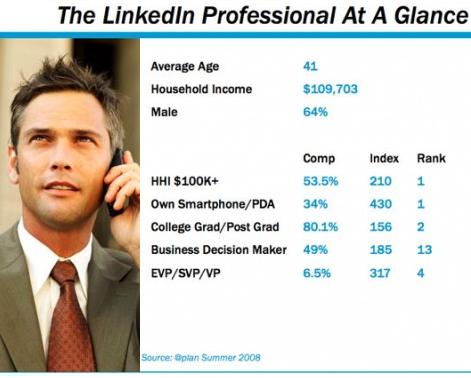
    By their own estimates, LinkedIn is signing new professionals to its social network at a rate of one every second of every day. In just four years, the site has become de rigueur for executives looking to build their network of contacts. Which is, well, everyone.

    It’s an impressive network. Below is a recent summary of who can be found on the site:

    A rundown of who is on LinkedIn
    A rundown of who is on LinkedIn

    The meteoric growth of LinkedIn’s member base means that compared to two years ago, I now rarely search for someone within the site and not find them. And every time I do find someone and add them as a business associate, my own network grows.

    Last night I decided to put this ubiquity to the test. For those I spoke to whom I truly saw a value in keeping in touch with (and they with me), I did something different. Instead of simply exchanging business cards, I used my smartphone to go into LinkedIn, search for them, and invite them to add me as a contact.

    Now I have something even better than a business card. I have a database entry of these contacts that changes as they move through the ranks of their company, or a future employer. And they have an opportunity to contact me with a favor or other request for assistance — which is, of course, the lifeblood of good business networking.

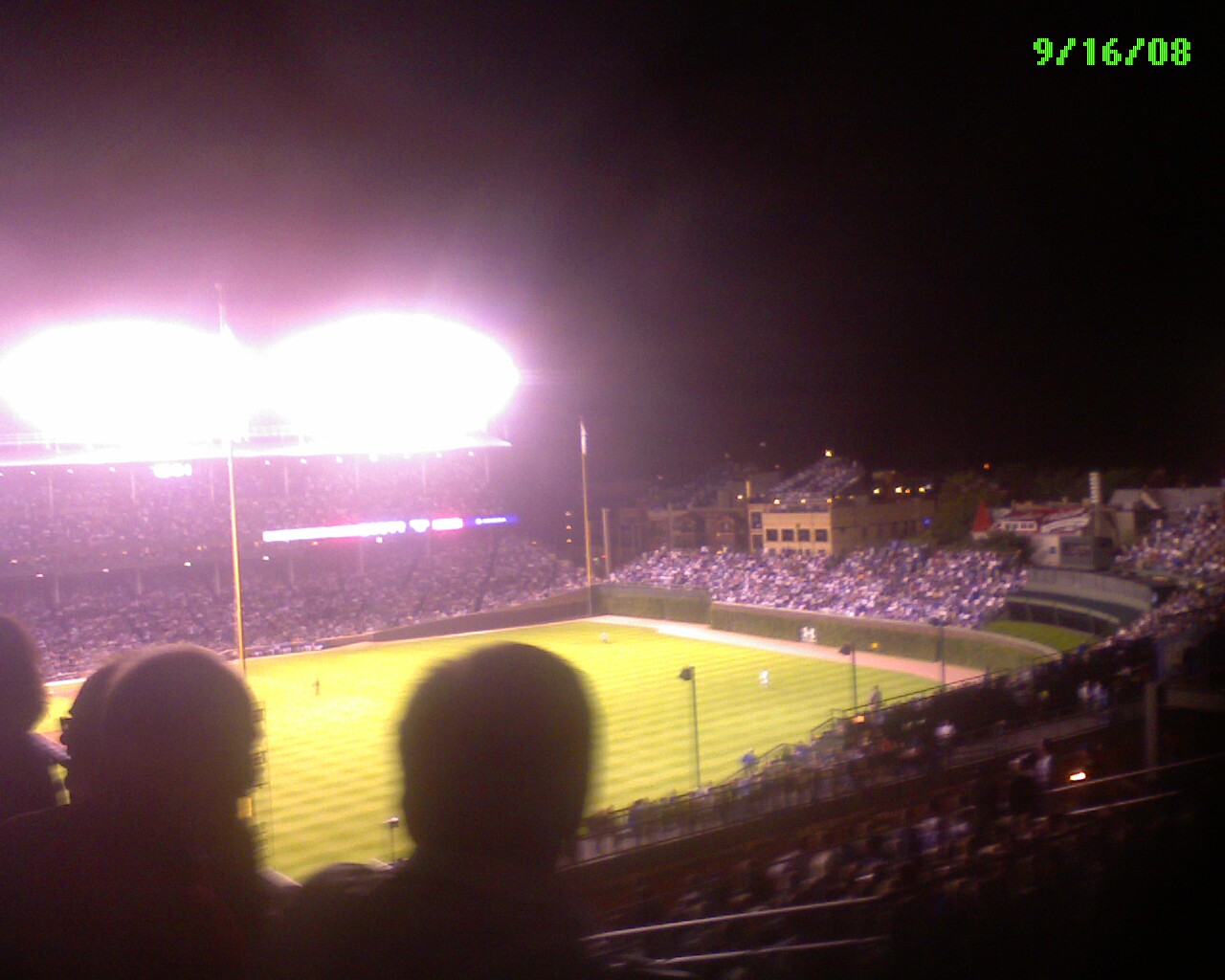
    Looking back at these two firsts from last night, I can tell you I will definitely use the LinkedIn technique again, where appropriate. As for rooftop voyeurism, I must say it was better networking than “spectating.” This shot of my view (unaided by the dozens of big screen televisions throughout the facility) was taken by my smartphone.

    The baseball is over there somewhere!
    The baseball is over there somewhere!

    P.S. Too bad about the Brewers. Better luck tonight in Game #2 of there three-game Chicago line-up.