Author: Jeff Larche

  • With Google for Print it’s all about reach

    Last year Google tested their ad auction concept in the print advertising space. Bill Wise in MediaPost had a theory for why this pilot wasn’t a huge success. In a word: “scarcity.”

    Google AdWords succeeds because there are only so many people searching for a term on any given day, and therefore only so many ad impressions than can run in front of this audience. It’s a finite supply of ads, and one that is perishable from one day to the next. Auctions are a perfect way for Google to optimize ad prices.

    But printed publications are different. If a newspaper or magazine sells more ads, they can print more pages to accommodate those ads. (Do you remember how fat Business 2.0 was in the heady months before the Dot Com Bust?)

    Google failed last year, but they aren’t giving up. They’ve just announced a deal that will include placement of select Google AdWords participants in The New York Times, The Washington Post, The Boston Globe, the Chicago Tribune and many more. Later in this test they plan to expand into weekly news magazines.

    It fascinates me that they are looking at getting involved in the very medium whose circulations they are helping to shrink. In the last six months the average circulation figures of daily newspapers have fallen another 2.8 percent, according to Dan Mitchell of the NY Times. True, he tries to put a positive spin on this news, citing a statistic that if you factor in online versions of the publications, readership is actually up significantly. But that actually helps to make my point: Why isn’t Google satisfied with running their ads on the fastest growing portion of the news business?

    I can only think it’s reach. And I don’t mean just readers. I’m thinking portability.

    Until this county develops a taste for news delivered to a cell phone or PDA, ink on paper is still the most reliable way to follow Americans into the many nooks and crannies of their day.

    I’m only half joking when I speculate that Google may have realized that their AdWords were doing wonderfully in the American office and den, but were failing miserably in the bathroom.
  • Verbing your trademark away, and why no one was ever caught yahooing

    One of the web’s most famous trademark owners recently had a conniption about people using “to google” and “googling” generically. Today another victim of this brand name erosion — think permission marketing — offers some great advice on branding in the Internet Age. The gist: Chill out. But overlooked is how Google’s superior search engine isn’t the main reason it is them crying in their beers instead of Yahoo.

    Mr. Godin takes the long view of these trademark infringements. If someone starts using your brand name generically, and you own that domain name, how much real brand damage can be done? Consumers can find you even if they don’t google you. Oops.

    He then talks about the ability of consumers to “verb” your brand in the first place. Comparing two popular social bookmarking sites, Digg and Reddit, you can easily see why only one of them is at risk of genericide. It sounds meaningful when you digg a site. Not so much if you reddit.

    Naseem Javed, author of Naming for Power and Domain Wars, sheds more light on how some names are easier to verb than others:

    Studies have shown that certain alpha-structures do not easily lend themselves to verbing. Despite their fame and popularity in daily language, these types of names survive over time and remain powerful corporate brands while enjoying a proprietary status. Some examples are Yahoo, Apple, Netscape, Telus, Microsoft, Sony, Rolex and Nintendo. Have you ever heard, “I Rolexed and realized I was late?” or, “Leave me alone, I’m Appling”?

    Unlike Mr. Godin, Mr. Javed thinks Google’s easily verbed name is serious reason for concern, and calls this misuse of the brand name, “A corporate nightmare — a code-red alert.”

    Which brings me back to Yahoo. They should be happy, right?

    Ten years ago when they had a similar market share to what Google has today, people were rollerblading and fedexing but not yahooing. What if people were yahooing in the pre-Google era? (And yes, they actually tried to trigger a trend, with their “Do you Yahoo?” campaign of a few years back.)

    If that were so, and the dictionaries featured them in their pages, Google would probably have a little less of the search market today. That’s because folks would sometimes assume someone really did go to Yahoo when they said they yahooed. But they don’t.

    If I were Yahoo, I would side with Seth Godin. And I would consider the lack of genericide of their brand name a corporate code-red alert.

  • Two Flashy search engines vie for eyeballs

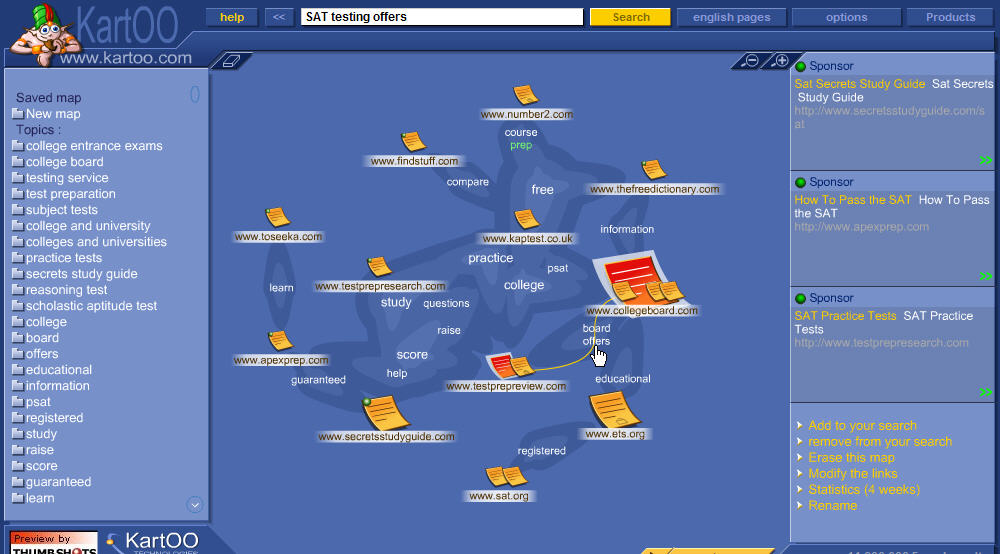
    What if you were presented with the challenge of grabbing a piece of the search engine pie? Two development teams approached the challenge with the same programming application and produced results that could not be any more different. First on the scene (by several years) is the people at KartOO Technologies. Their search program can be found at KartOO.com.

    Click for a larger graphicThese folks specialize in organizing information visually. In the example to the right, I searched for “SAT testing.” The results are plotted out as though they were clusters of information islands. I then moved my mouse over a word in the middle of several islands (“offers”). The modifier showed up in the search box, and the items related to “offers” are highlighted and joined by curved lines. It’s a clever way to parse through popular ways that pages are related — all in a visually entertaining (well, as least intriguing) experience.

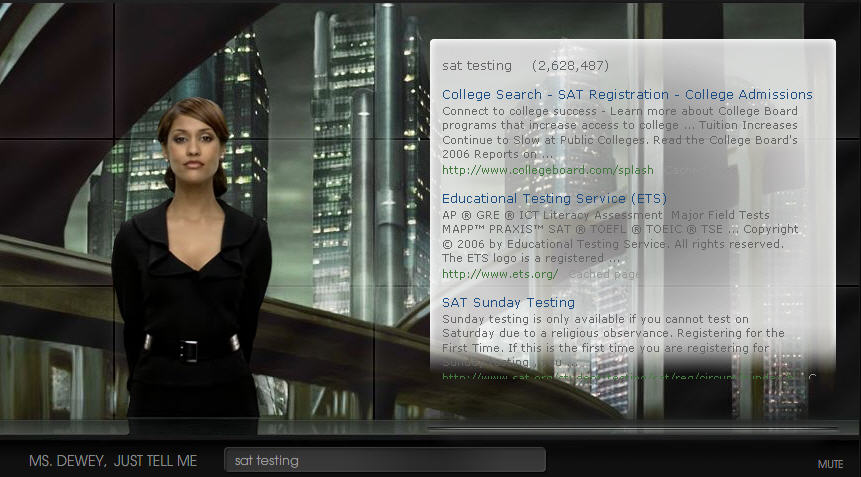
    Entertainment is definitely the goal of this most recent competitor in the search engine category. I won’t add to the din of bloggers commenting on Ms. Dewey (msdewey.com). All I will say about this comely peer of the late Jeeves (of Ask.com) is she is the most video-centric — and talkative — search experience you are likely to find. And the developers? None other than Microsoft Live Search.

    Click for a larger image

    Two Macromedia Flash search engines deliver two extremely different experiences. Which is more successful?

  • Burger King masks and eBay are big this Halloween

    Before the internet there was little chance for enterprising types to profit from holiday-generated scarcity. I’m thinking of the Cabbage Patch Kids dolls, which were the must-have collectibles for much of the 1980s, and caused frenzied pre-Christmas rushes at bricks-and-mortar stores. Now there are online markets to help resolve supply / demand imbalances. I was reminded of this as I talked to my friend at BuyCostumes, the world’s largest e-commerce costume site.

    Earlier this month I wrote that if you remove the constraints of shelf space dictated by a physical costume store, you see the same Long Tail sales trends that other categories experience (at BuyCostomes, at least). When variety of product is virtually unlimited (pun intended), niche sales can be very profitable.

    Conversely, when there is a lot of demand for something in limited supply, not only will you sell out quickly, but you’ll see that product continue through the food chain until it finds its ideal price. Certainly for Christmas items, but also for Halloween, which is now the second largest American holiday in terms of spending.

    A fact I was reminded of when I learned that Burger King costumes are big this year.

    BuyCostumes has an exclusive deal to sell these masks this year, and sold nearly 2,000 of them over the course of about 6 hours (cumulatively, because they sold them in batches over several days).

    The retail price was $39.99. Many who scooped them up immediately put them back on the market. My contact at BuyCostumes guessed they were going for as much as $80 each on eBay and finally settled down to $65, including shipping and handling. Unfortunately, the speculators, plus eBay and perhaps pay-per-click ad sites (see the ads on the Google search I did this weekend) were the only parties to profit from this demand spike.

    For several years I’ve been reading that movie theaters are talking about putting their tickets for extremely busy nights up for a higher price than normal, and conversely, marketing their slow nights at lower ticket costs. That day is still a long way off, for social reasons and not technical ones.

    Similarly, I wonder if holiday-related e-commerce sites should consider having their own markets for their hottest products, so they can benefit from these demand spikes. After all, oil companies do it. And isn’t a Burger King mask that can be re-sold many times on eBay and Craigslist just as fungible as a gallon of sweet crude?

    The only constraint I can think of: Society may not be prepared to have a merchant with exclusive rights to a product take every action to benefit from its popularity. The negative PR implications of an online auction by the seller may be too great, leaving the opportunity in the hands of the speculators and eBay.

    You’ve got to wonder. If the frantic parents outside the toy stores of the 1980’s were told there would be an auction for the last 10 Cabbage Patch Kids, and “Who will start the bidding at $100?” … would there be a riot? And would there be a flame-fest from consumers if modern-day eTailers did the same?

  • The persuasive power of a map

    David Ogilvy called direct marketing, “My first love and secret weapon.” I feel the same way. The power of a handful of direct marketing techniques has turned so-so campaigns into winners for me more times than I can name. One such technique is including maps in direct mail and email marketing messages. I’ll break the marketing power of geomapping into two tips.

    #1 Don’t just tell consumers that they should visit you — show them how, as specifically as possible

    Social psychologist Howard Levanthal conducted some experiments in the 1960s to see if he could persuade Yale University students to get tetanus inoculations. In his efforts to see if mailed brochures would work better using fear as a motivating factor, he stumbled upon something more persuasive.

    He included a change in the booklet that boosted response from 3% to 28%. As reported in “Effects on Fear and Specificity of Recommendations Upon Attitudes and Behavior,” in the Journal of Personality and Social Psychology (1965), he and his fellow researchers included a map of the campus, with the Health Department office circled, and the times when inoculations were being offered.

    In other words, he made visiting the health department more real to the students by showing them how it fit into their lives and their schedules.

    With digital printing, you can do one better: You can produce maps that include two dots: You are here and Here we are. I’ve used this technique, and it’s not easy when you’re mailing to a lot of neighborhoods, but seems to be well worth the effort.

    #2 Tell them how close they are to you

    People don’t look at maps until they are curious about what you have to sell. But you can help them grasp how easy it is to reach you if you tell them right in the headline. If they are closer than they thought, that’s great news. And to quote Oglivy again, “All advertising is news.” Here’s an example of one such headline:

    We had the challenge of informing residents living near a community hospital that they should go there for the vast majority of their healthcare needs. The hospital, which was tucked away in a residential neighborhood and was easily overlooked, had witnessed much of their business being drained away by a neighboring medical center.

    Our opportunity to start winning this business back came when we were hired to promote a series of open house events (by we, I’m referring to a team I led in a “former life,” as they say in business). The events were to celebrate a complete redecoration of the public-facing areas of the facility.

    The headline of the mailing was blunt: You’re less than 10 minutes away from award-winning healthcare. We could say this honestly because we had done drive-time calculations, and created three versions of the mailing. One stating the above, and two others saying 5 minutes and 15 minutes. The database with drive times told us which mailing to use for each address.

    When the first event rolled around, it was fascinating to watch people arrive, with mailing in hand, to claim the promotional item we were giving away. They needed to take a tour and turn in the mailing in order to get their gift. That, of course, meant that we could read their names and addresses off of the cards, and add these prospects to a customer relationship management (CRM) database. From there we could re-mail with other offers and news.

    It was definitely a group of pospects worth re-marketing to, for these three reasons: 

    1. They were responsive. The response rate for the group closest the hospital was 3.7%.
    2. They loved us. Many raved about what they saw, saying things like, “It looks more like a hotel lobby than a hospital!”
    3. They were now truly our neighbors. Thanks to the geomapping technique, they all knew exactly how to find us.