Author: Jeff Larche

  • Potential risks from homegrown Super Bowl ads rival the action on the field

    It’s hard to believe it was eight years ago when Victoria’s Secret aired its first-ever Super Bowl commercial, announcing the live webcast of a Spring Fashion Show. Like yelling free beer in a crowded frat house, the ensuing stampede crashed the company’s servers. The injury!

    More recently, GM invited consumers to create and post their own videos extolling the virtues of the Chevy Tahoe. The entries were not entirely what GM expected. The humiliation!

    Online buzz surrounding this year’s Superbowl ads was about the various contests for the best user-generated ads. And America was watching, not so much to see which sponsors leave the event victorious, but to see what brands got carried off on stretchers.

    Like the game these ads interrupt, this was a high-stakes and risky competition. Especially this year. What makes this particular Grand Guignol so riveting was that the rules are not fully written. Will sponsors trying to open up their ads to the masses be able to keep out the cheeky smart-alecs from the proceedings?

    We knew they could control the ads that are shown on the actual telecast. But what about the real user-generated videos that will follow?

    Dale Bachus, winner of Doritos Superbowl ad competitionDoritos tore a page from the new media playbook. They announced the challenge under a tight deadline — late last year — and opened the videos to American Idols-like voting, thus absolving themselves of responsibility for a bad choice. In an additional, shrewd move, they ran the winner early enough in the game to call it “world’s first fan-produced Superbowl ad.” The winning ad was only so-so in effectiveness — unless you consider the ad’s budget and production timeline (two digits and four days).

    I’ll be adding updates to this post as I see what the true ROI is for the user-generated advertisers in this year’s Superbowl, especially Doritos. One possible help to this brand: Dale Bachus, the leader of the winning ad (shown here) has a delightful story to tell. One possible threat: Snarky video producers on free-rein sites like YouTube, deciding to do their own, unauthorized Doritos ads.

    If any of them catch fire the way the Chevy Tahoe ads did, their stories will be the ones consumers remember.

    Stay tuned.

    Superbowl night postscript: My favorite user-generated ad was the NFL ad shown at the two-minute warning. But maybe it was because the pay-off was a cameo by Brett Favre, in a sly reference to his recent announcement of not yet retiring. What can I say? I’m a Wisconsinite.


    Update: Sunday, Feb. 11, 2007

    It’s been a week since this post first aired and sadly I saw none of the insurrection one would expect of the same people who savaged the Chevy Tahoe and lonelygirl15. What’s with people nowadays, when you can’t see some user-generated vitriole? Here’s what I did observe:

    • Cymfony.com did an excellent job of rating the ads, both before and after they appeared during the Superbowl. The Dorito’s ad did extraordinarily well in its consumer tests. The fact that it didn’t thoroughly excite anyone is expected. It offended nearly no one, according to Cymfony’s polling. (Here’s a demonstration of this phenomenon: Think of a dozen people you know and try to imagine of a restaurant they would all enjoy. Now try to think of one they’d all like that isn’t boring and “safe”).
    • Many advertisers tried to leverage their ads through online campaigns, but the most successful, I suspect, were CareerBuilder’s. Those who understand the power of the internet to drive web traffic (see the Victoria’s Sectet example at the beginning of this post) were the target of the following ad. It urged readers to post on CareerBuilder because the web traffic following the Super Bowl would be huge. This is a believable proposition, especially to those who remembered the inspired monkey ads from last year and the year before. I’m sure the web-based ads worked well, but according to Alexa (see the graphic below) the bump in traffic was nothing to write home about. This year’s CareerBuilder ads were underwhelming.
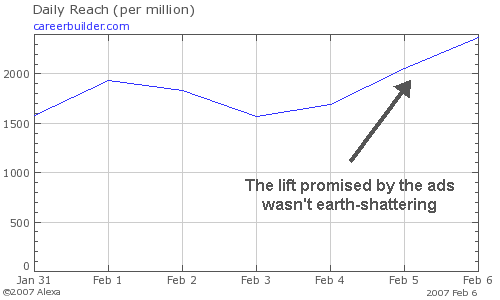
     The reach of CareerBuilder surrounding the game

  • Quantifying the offline purchasing impact of search

    When an online search becomes an online sale, that conversion can usually be measured. That’s how you calculate the true ROI of sponsored search listings. But is there an additional, hidden value to that investment?

    Consider these examples: 

    • A j.jill online visitor — who got there through a Google search – decides she really needs to try on the jacket she found in a store. She goes there based on her online search and makes the purchase there. 
    • A search on a favorite author causes someone to browse the virtual stacks of Barnes & Noble. Later in the week he buys the book at a bricks-and-mortar location.

    Those examples don’t include business-to-business purchases. For instance, someone needs a widget, so they type the phrase into a search engine. This person finds a promising widget merchant, but closes the deal much later, via phone and email.

    How do you capture the value of those original search listings — whether they are paid or organic?

    ROI Research attempted to find out (in the b-to-c space, at least), and their findings turned up some provocative numbers, including the following:

    • As many as one out of every three offline purchases was precipitated by an online search
    • Search can influence an incremental 3 times the dollar value of e-commerce transactions by reaching consumers who shop in traditional channels
    • Those who search up to 10 times annually spend an average of $1,789 online
    • Those who searched 31+ times spent an average of $2,943 online
    • As you might expect, off-line purchasing volumes went up as well with the number of online searches a consumer made in a year.

    Take-away:

    As measurable as search engine marketing is, its full value is much larger than what you see in ROI reporting. For the right keywords, the search engine results pages become ad hoc portals attracting people more likely to purchase, both online and offline.

  • In b-to-b marketing, fear and greed are all you’ve got

    Years ago a mentor told me that in consumer advertising, there are many motivations for someone to act. But when you’re talking to someone about a product or service for their business, the motivations are less varied. In fact, they boil down to two:

    • Fear
    • Greed

    Period.

    That was nearly 20 years ago. A lot has changed, but I cannot see any evidence that this has changed at all. Your thoughts?

  • Ads with prancing cowboys may annoy, but they sure do work

    Not all online marketers can make this claim, but if you peered into my soul (or some would say analyze my circuitry), you’d see a direct marketer. I’m proud of it. And I feel vindicated when I read articles like today’s in the Advertising section of the NY Times. It’s about LowerMyBills.com and how they’ve annoyed millions with their silly online ads. And made a fortune. Here’s an excerpt:

    The company, one of the Internet’s biggest advertisers, routinely festoons Web sites large and small with its ads, spending $74.6 million on them in the first 11 months of 2006, according to TNS Media Intelligence. The surprising success of the ads led LowerMyBills to a significant payday: the credit agency Experian bought the eight-year-old company for $400 million in 2005.

    Example from the NT Times  article of a LowerMyBills adBut on the path to prosperity, LowerMyBills has run into a lot of people who say the undulating characters in the ads are highly distracting and have so little to do with low-interest loans that they border on the surreal.

    The most memorable LowerMyBills banners feature silhouetted dancers like the prancing cowboys, or the couple doing a jig on their roof under a full moon.

    As a direct marketer, I know that the only way you can tell if an ad is working is by testing. And there is little logic to what works and what doesn’t.

    My background as a direct marketer makes me passionate about the opportunity that the web provides to test many creative concepts and refocus spending on the best of those, in a matter of hours instead of weeks (as is the case with direct mail). This same background makes me quite boring. When I client says, “Should we do it?” — whatever it is — nine times out of ten I have to tell them, “Let’s test!”

    Congratulations, by the way, to James Gardner, whose online “hobby,” Adverlicio.us, got him some ink in the article. He’s a great guy and deserves all of the attention this article is sending his way.


  • The collaboration technology of choice varies by marketing discipline

    Today I had lunch with my friend Don Buck of Buck Marketing. He owns a list brokerage. I was explaining why I had not yet installed the program he swears by, Trillian by Cerulean Studios. It’s a way to aggregate all of your instant messaging (IM) identities into one account. That way, regardless of which system someone wants to reach you in — AOL, MSN, Yahoo, Google (Jabber) or a less popular IM account — you can receive and send through one account.

    Pretty clever. But it was a solution to a problem that I don’t have.

    I only have Google IM, and that’s primarily to communicate with my team members. Few people beyond my coworkers are in my Google buddy list, and I have no need for other accounts. Don said, “That’s interesting but not surprising. I find that my contacts in the email marketing industry use IM to do their work, but those in direct mail use email.”

    I have a theory why. Direct mail takes weeks to plan and execute, as do most other marketing projects nowadays. Passing information via email is sufficient to meet those types of deadlines.

    Email projects are usually more immediate — at least when you are in the execution stage. We’re talking lag times of days instead of weeks. IM may be the only collaboration technology immediate enough to keep things on track and still keep a record of what’s discussed (otherwise you can just pick up the phone).

    Or perhaps it’s something else that turns email marketers away from their lingua franca. Perhaps those who send emails for a living can’t bear to lean heavily on that medium to manage the projects. Sort of like the guy who makes donuts every morning never wanting to sample his own work.