Author: Jeff Larche

  • Radiohead and Fake Science meet differing fates in the DRM-free tar pit

    This week two emails hit my Inbox within hours of each other. The first was from the site selling Radiohead’s latest CD via download. It was confirming my order, with a specific price tag that was more of a surprise to them than me, since it was I who chose it a few minutes earlier, during the ordering process.

    News on the street, and from Radiohead management, is that tens of thousands of others played the same “Name your price for this CD” game, at a level equating to a little more than $8 US. (11/9/07 Update: The real figure appears to be only half of that $8 estimate.) Not too shabby — especially since there was no DRM (anti-pirating protection) on the downloads, and the band was basically doing the digital equivalent of busking: Opening their guitar cases to collect whatever money listeners want to throw their way. (They also sell a fixed-price, $80 “Disk Box” for Radiohead completists.)

    The second email was from a small, audacious music store site that announced it was closing shop. FakeScience.com is a source I’ve enjoyed for fun, mostly ambient electronica.

    At $5 an album, their DJ artists — with names like Dr Toast — provide perfect musical soundtracks to knowledge working and long drives. Here is what the email from the gang at Fake Science had to say:

    It is with a heavy heart that we must inform you that on November 1st, 2007 we will be closing the Fake Science Music Store. Fake Science was originally started as a labor of love by four friends who had an idea to help share music with people like you and has since grown into the online music resource it is today. However, we evaluated the amount of investment that it would take to keep the store running, as well as making necessary upgrades to keep the Fake Science standards high. We came to the realization that none of us could realistically keep the commitment due to the weight other important things in our lives, such as families, day jobs, and even other side projects.

    This sounds like the explanation I’ve heard many times from musician friends, when they announce that their garage band is breaking up after graduation. The explanation is always sincere — and quite valid, considering the economics of music.

    But doesn’t the long tail mean that everyone with talent has a shot at recording stardom, or at least economic viability?

    Aside from “families, day jobs,” etc., what caused Fake Science to sink into the DRM-free equivalent of the prehistoric tar pits, while Radiohead’s experiment has — by all accounts and speculation — flourished? I believe economist and author Tyler Cowen nails it. He provides five reasons in his Marginal Revolution post:

    1. Radiohead is an indie cult band with extreme loyalties from its partisans and the possibility of attracting more such partisans by seeming “cool.”
    2. Radiohead peaks high on the charts (#3 for their last release, if I recall…) but I believe they sell the product pretty quickly and don’t have a long run at the top. Again, they’d like to widen their fan base.
    3. Radiohead’s gambit has reaped enormous publicity, but this won’t be the case next time.
    4. Many donors will give to a highly visible “cause of the month” (remember the outpouring of support for the tsunami victims?) but they won’t necessarily give on a regular basis.
    5. Radiohead probably has an especially high ratio of touring to CD and iTunes income; see #1. This scheme is a natural for them but not for Kelly Clarkson.

    Do read the comments of this blog entry for some interesting clarifications and opposing views. Nonetheless, I think Cowen’s points are all valid.

    What’s more, I’d like to add a #6 to the list. Another reason why struggling artists won’t be reaping the benefits of this Radiohead “donor” experiment is what I’ll call The Prius Factor. A recent New York Times article points out that part of the tremendous success of the Toyota Prius hybrid is that it was built to be nothing but a hybid. This is in stark contrast to the major hybrid offerings by Ford, Honda and GM’s Saturn, where they started as traditional internal combustion vehicles. You have to look for a small badge on the trunk or side panel to know that any of these other cars is an environmentally friendly gas/electric hybrid.

    That suggests, according to the article, that the Prius has become an “issue bracelet.” It’s a theory supported by research reported in the same Times piece:

    … More than half of the Prius buyers surveyed this spring by CNW Marketing Research of Bandon, Ore., said the main reason they purchased their car was that “it makes a statement about me.”

    In the weeks to come, people will be hearing songs from Radiohead’s (quite good) In Rainbows. Those who are fans will undoubtedly be asking the person playing this CD: “So what did you pay?” Like the overtly hybrid Prius, it’s an easy conversation-starter. Surely, Radiohead’s CD will be the catalyst for many a new friendship or hook-up.

    This is bad news for the relatively unknown Dr Toast, and other Fake Science musicians. But there is hope that this business model could quickly morph to benefit all artists, given the accelerated Darwinian ecosystem of the internet. (And according to a fun NOFX song, dinosaurs will die).

    Oh, and there is one final thing Tyler Cowen nails in his assessment: Kid A truly is Radiohead’s best album so far. Which just goes to show that even respected economists can’t resist sounding cool with a little musical name-dropping.

  • BarCamp Milwaukee reflects the wealth of talent and intellect in my city of choice

    This afternoon I attended Milwaukee’s second annual BarCamp, which is about a lot of other things, but is primarily smart and creative technologists coming out to play. (The tag clouds below are from the BarCamp Milwaukee site, where attendees are asked to state their interests in the same way that presentations / activities are given relevant keywords.)

    BarCamp TagsIt was stimulating to experience the free-form workshops, and exciting to imagine what this event will grow into with a few more years of publicity and support.
    As I write this late on a Saturday night, the events are still taking place. BarCamp runs non-stop through tonight and into Sunday afternoon. When I return to give my presentation at 10 AM tomorrow, it will be interesting to see the level of wakefulness of my audience.

    Under the influence of seminars on topics like improving streaming video and using Ruby On Rails to build better sites, I couldn’t let the night go by without doing at least one software change to improve Digital Solid. It’s nothing you can see, but I’ve removed the nofollow attributes that appear in links with the comments that people leave.

    Thank you Douglas Karr of The Marketing Technology Blog for this important search-engine-related modification to WordPress blogs (like this one). Doug, I owe you a lot. You’ve given me the strength to face a roomful of mostly developers tomorrow morning, safe in the knowledge that I too can hack code — okay, when given simple and explicit directions!

  • Unilever discovers, then embraces, the power of online social media

    As a marketer I read too many cases about companies who do one of the following:

    1. Ignore the power of online social media, in spite of their brand being ideal for its careful use
    2. Run headlong at this Web 2.0 phenomenon, throwing caution to the wind, only to do more harm than good to their brand

    danah boyd [sic], the well-known anthropologist and “youth and technology” expert, gives a very personal account of the spread of Unilever’s Dove Evolution campaign. It’s a case study for how an exceptional marketing idea can gain legs through sites such as YouTube.

    In the post she recounts how she was acting out of what she perceived as the public good, and not as some shill for the brand. Truly inadvertently, she says that she became “a marketer’s dream.”

    I agree. But what still amazes me is that similar efforts for less savvy brands would be viewed by their stewards as unacceptable — nothing more than the unauthorized spread of their content.

    These folks would look at the Danah Boyds of the world as more of a nightmare than a dream. Go figure.

  • Jeff’s first Pecha Kucha

    It was actually Charles Dudley Warner — and not Mark Twain as is commonly thought — who first quipped, “Everybody complains about the weather, but nobody does anything about it.” Boring slideshow presentations come in a close second behind the weather for producing the most heat for the least real flame.

    As I’ve noted here before, Edward Tufte is that rare exception. He’s written extensively on alternatives to the presentation status quo.

    On the other hand, the inventors of Pecha Kucha tell the press that they have no goal more lofty than putting butts in seats at their Tokyo performance space. But I really think they’re onto something.

    [youtube C_5l6hXwzUo]

    As I mentioned a few days ago, I presented my first Pecha Kucha on Saturday, to support the discussion of a new web metric called the Content Interest Index. Today you can find it posted on YouTube (embedded above), to make viewing and sharing a little easier.

    I hope to soon attend my first Pecha Kucha performance event in Chicago (the date is TBD), where I know the quality of the presentations will make me glad I didn’t quit my day job. But until I see what a real Pecha Kucha can do, I’m fairly happy with this quirky way to explore an otherwise “bland” topic. I’m also glad to do my part in “doing something” about the scourge that is SDD (Slideshow Deficit Disorder).

  • New billboard mascot is another case of Analog = Tired, Digital = Wired

    When I was in high school, in my sleepy, remote hometown, the local shopping mall wanted to do something different for the holiday shopping season. Not content with a mere Santa Claus, they had plans to build and “populate” a talking Christmas tree.

    This hollow tree would contain a person — someone who would sit there all day and accost passersby, engaging them in clever yuletide banter. I must have gotten a reputation as someone who you couldn’t shut up, because I was offered the gig.

    I declined.

    I was 13 years old, and acutely aware that as soon as word got out I was the voice behind this blight on the retail landscape, I would become a serious candidate for after-school deforestation.

    Everyone knows that mascots are not cool.

    I must have given off a serious death wish, because I got a similar offer when I was in college. I was working as an intern at a bank.

    They were shocked and crestfallen when I told them no, I would not spend my weekends prancing through the aisles of our football stadium dressed as a giant foam checkbook. What could I be thinking? I’ll tell you what I was thinking: Mascots are not cool.

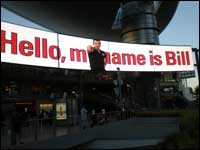
    The Digital MascotThat’s why I took special note when I heard this account on NPR’s On The Media. It’s of a mascot that is actually, certifiably cool. The podcast segment includes an interview with the actor who brings this mascot to life. And yes, he fully grasps that he has landed a truly plum job.

    He’s the star of an animated, digital billboard in Las Vegas. Hidden cameras and microphones allow him to carry on conversations with pedestrians, while images of the products and services he’s hawking stream and flash in the background.

    I’m still trying to fathom why this is so dramatically different from a talking Christmas tree in Escanaba, Michigan. I’ve concluded that it’s another example of The Age of the Nerd.

    If it’s digital, it is most likely pretty awesome.

    So, if the marketing department of that bank where I interned is reading this, I have something to say to you:

    I’m a little long in the tooth to sell checking accounts in football stadiums, but if the offer still stands, I’m your man, on one condition: It’s got to be electronic checking.