Author: Jeff Larche

  • Cheers to the barnacle app: a useful new entry in the Web 2.0 lexicon

    Last week I reported on a fun little social lubricant called Foamee. It is a third party trifle completely reliant (at least as of this writing) on Twitter. The objective: If you’re a member of Twitter, you pledge to buy someone a beer. Foamee keeps tabs on these declarations.

    Anatomy of a Barnacle AppAs I pointed out in my post, this application is part of a larger trend. Namely, that of launching a shoestring site that is financially independent of a larger site, but completely dependent on it for survival. It’s an interesting paradox, and all but cries out for a new piece of jargon. You know, something to toss out casually during your next new media PowerPoint presentation.

    Enter Joshua Porter of Bokardo Design. In his blog, Joshua dubbed this type of site a barnacle app. I think the term has legs (and the graphic above backs me up on this — at least, a barnacle has “feeding legs”).

    Do you agree? Is this a term worthy of surviving past its inevitable 15 minutes of fame in Wired‘s Jargon Watch listing (a recent example)?

    Also: What is your favorite barnacle app, and why?

  • Add the latest JCMC to your towering reading pile

    We’ve all got far more to read than time to read it, right? So you’re going to hate me for telling you this, but if you care about communication and technology, you should be tracking the Journal of Computer-Mediated Communication. Especially this latest issue, whose “special theme” is social network sites.

    Of particular relevance to marketing technologists are these articles:

    • Social Network Sites: Definition, History, and Scholarship
      danah m. boyd and Nicole B. Ellison
      This introduction describes features of social network sites (SNSs), proposes a comprehensive definition, presents a history of their development, reviews existing SNS scholarship, and introduces the articles in this special theme section.
    • Social Network Profiles as Taste Performances
      Hugo Liu
      A social network profile’s lists of interests can function as an expressive arena for taste performance. Based on a semiotic approach, different types of taste statements are identified and further investigated through a statistical analysis of 127,477 profiles collected from MySpace.
    • Whose Space? Differences Among Users and Non-Users of Social Network Sites
      Eszter Hargittai
      Are there systematic differences between people who use social network sites and those who stay away? Based on data from a survey administered to young adults, this article identifies demographic predictors of SNS usage, with particular focus on Facebook, MySpace, Xanga, and Friendster.
    • Mobile Social Networks and Social Practice: A Case Study of Dodgeball
      Lee Humphreys
      Dodgeball is a mobile social network system that seeks to facilitate social coordination among friends in urban public spaces. This study reports on the norms of Dodgeball use, proposing that exchanging messages through Dodgeball can lead to social molecularization, whereby active members experience and move through the city in a collective manner.
    • Publicly Private and Privately Public: Social Networking on YouTube
      Patricia Lange
      Based on a one-year ethnographic project, this article analyzes how YouTube participants developed and maintained social networks by manipulating physical and interpretive access to videos. The analysis identifies varying degrees of “publicness” in video sharing, depending on the nature of the video content and how much personal information is revealed.

    Juicy stuff. Enjoy!

  • Social networks for business verticals are less-known benefactors of OpenSocial

    The OpenSocial alliance among a variety of consumer social network sites (SNSs) — most notably MySpace — is designed to allow marketers to leverage as never before the word-of-mouth strength of a social graph. This story about the less-known business vertical SNSs (such as those catering to physicians and telecom professionals), reminds me of this exciting reality:

    Any b-to-b site with an active community and the flexibility of adopting OpenSocial can reap the same benefits.

    Below is Google’s somewhat dorky video explaining the OpenSocial API.

    [youtube 9KOEbAZJTTk]

    Also, here’s a terrific explanation of what a social graph is, why marketers should care, and what they should do with the sites they manage in light of this information.

  • Third party site works with Twitter to promote virtual IOU’s and real beer

    Twitter interests me more for what it foreshadows than for what it does. This micro-blogging system is currently little more than an electronic water cooler, where information workers and students can socialize and blow off steam. But it also has aspects of a social network — a very open social network. And that means it has the potential for some exciting innovation.

    I look at Twitter as a VisiCalc of this era. VisiCalc was the first spreadsheet program for the personal computer. Primitive by modern standards, its greatest feat was setting a new paradigm. Spreadsheet progams look odd to those who have never used one, but for adopters, it is a powerhouse– something that many couldn’t imagine working without.

    Of course, that’s the magic of the paradigm, not VisiCalc specifically, which was usurped by competitors within a few years of its release.

    Sooner rather than later, a Twitter competitor will take the new behaviors of microblogging and deliver something extraordinary. This will be something we would not want to live without. Similar to Excel, this competitor will arrive with bigger, smarter features and scoop up market share.

    Or maybe I’m wrong and Twitter will do the impossible. Perhaps it will be able to hold onto and expand its base of users as it morphs from networked toy to networking tool. Here is one ray of hope for Twitter that they will have a better chance than VisiCalc did: Twitter courts and encourages third party developers.

    May I Buy You a Beer?

    Which brings me to the latest Twitter-affiliated innovation: Along with Foamee, Twitter users can now publicly proclaim their intentions to buy someone a beer. Foamee then tracks the IOU, and even allows for scores to be settled and ledgers closed. Good work, Dan Cederholm of SimpleBits Design, for this fun Twitter add-on. Here’s a screen cap showing my IOU (middle posting) from this morning:
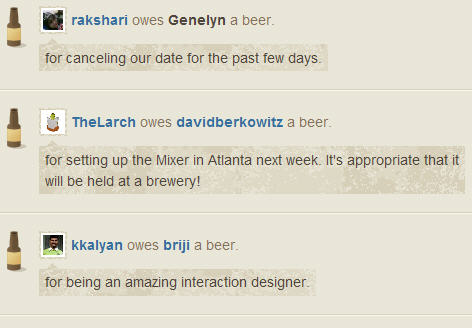
    A Foamee Thread

    Twitter continues to innovate by opening up to the creative community at large (another fun example is this mashup: TwitterVision). How incredibly smart. This week at ad:tech New York, Google announced it has organized several major social network sites to back an open source way of building and sharing widgets. It’s called OpenSocial.

    The folks behind Google (and its own social network, Orkut), wisely recognize that innovation can only be accelerated through the “network effect.” And innovation is, after all, a key to survival. They might have even been inspired by watching Twitter.

    If so, Google owes Twitter a beer.

  • With Bizographics, ZoomInfo unveils a novel step toward more targeted b-to-b marketing

    It’s a silly name but a sound concept: Segment the registered users of your site by industry, company, title, education, seniority and role within the company. For good measure, throw in some traditional demographic items like location and gender. ZoomInfo calls this bizographics, or business demographics. The new ad offering was just announced to the press, and at the ad:tech New York internet marketing conference.

    In his most recent blog entry, senior ZoomInfo VP Russell Glass gives the following example of how bizographics can precisely focus an online ad’s viewers: “[a company offering an elite credit card] would have the ability to place advertising in front of users that fall within the “senior executive” bizographic, and focus messages based on this targeting — i.e, ‘CEOs now hear this.’”

    Frankly, I don’t see that as being the best example of the power of this new ad platform, because the same ad buy could be made on sites specifically visited by senior executives. But I certainly see the potential. For much of my career I’ve yearned for a way to reach, say, “service industry executives with HR responsibilities.” If ZoomInfo’s system can allow for that type of pinpoint marketing, I see bizographics succeeding in spite of its unfortunate name.

    Update 11/06/07: ad:tech is the stage for another, and similar, announcement. Facebook certainly has its share of user information to mine for ad value. Today one of CEO Mark Zuckerberg’s big announcements was the launch of an ad platform called Social Ads. This targets ads based on member profile data and “spreads” these ad virally. It appears to be a B-to-C version of Bizographics. One that naturally has far greater reach. Scratch both of those statements. A clarifying article on 11/07/07 talked about what makes Facebook’s offering unique from other ad platforms. It doesn’t necessarily make for far-reaching ads. But their impact could be much greater, due to a word-of-mouth effect.