Author: Jeff Larche

  • Four secrets to online video demos that break sales records

    A friend of mine got his start in marketing as a carnival pitchman. He would travel the country, selling electric blenders from a dusty demo booth. He was good. Really good. He once told me that a key to success on a highly competitive midway was being sure to gather a large crowd. In carny lingo this is called building a tip.

    The web has replaced the carnival back lot. Search engines, online ads and other techniques do the job of building a tip. And once a visitor arrives at a site, today it’s often a video that gives the pitch.

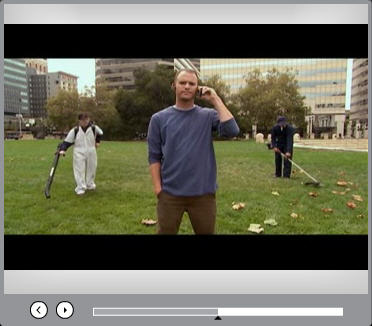
    I was blown away recently by just such an online pitch. It was for Jawbone, a noise-canceling Bluetooth cell phone earpiece. Below is a link to the site, where you can watch the full video:
    Jawbone Video Demo Page

    If you’re like me, you were immediately sucked into the demo. That’s a key to a good pitch. Lead strong, without ever overdoing it and scaring your tip away. Here are three other things this video does right:

    • Feature a pitchman (or woman) — Selling is always one-to-one, whether it’s to a throng of carnival revelers or to thousands of isolated web visitors. Similar to other direct sales media, such as direct mail, you cannot achieve record-breaking sales success online unless you are persistent in hammering away at the value of the product. A disembodied voice-over cannot make the necessary level of personal connection.
    • Use drama — People buy things because it makes them feel good. There is pleasure in finding something that can improve a life. Whenever possible, illustrate dramatically how your product can do this. On the midway, my friend would chew up nuts and bolts in his blender. It was a loud, suspenseful, almost scary way to demonstrate power and durability. Then he’d replace the metal blender carafe for a glass one and cram it with fruits and vegetables — pits, stems and all. In what seemed like an instant he had made fruit smoothie samples for the audience, further showing the machine’s power and versatility. My friend made this device seem almost magical.
    • Build to a strong finish — Selling is ultimately about theater. That means you should follow the same story arc most commonly used in entertainment. Bring your audience’s interest to a crescendo. Work their emotions until they cannot imagine what will happen next, and are hanging on every word and new development. Then make sure they understand that when your pitch ends, they are expected to take out their wallets. If you’ve done your job right, they will!

    Ironically, last month I stumbled across this YouTube video. It’s for a high-powered blender, not unlike the kind my friend sold back in his pitchman days. This video breaks all of the rules of a good demo. I’m not surprised that one and only comment left at the bottom of the video reads as follows:

    The Vitamix may be a good machine. But there is no way I’m paying $400 dollars for a stupid blender. I don’t care how good it is. If I had Bill Gates money I wouldn’t spend that much for a blender. I’m sure there’s a machine out there that’s just as good with a much nicer price. And I’m going to keep searching until I find it.

    Ouch! Sorry, Vitamix. While showing all the tricks that this blender can perform, you failed to sufficiently build its value. You’d never survive a day on the midway.
  • Research confirms it: Folks are less likely to consider a brand they don’t find in search results pages

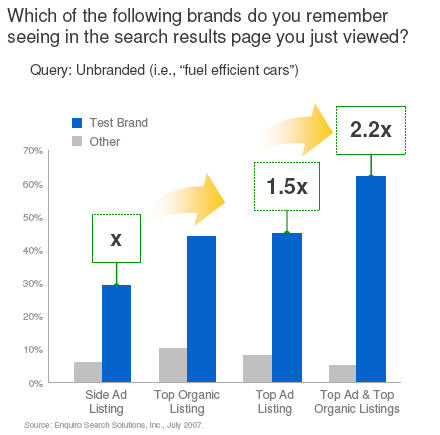
    The revelation that you risk losing business if prospects don’t find you in search results is just one of the conclusions from a newly-released research study from Enquiro (registration required). This report is packed with valuable insights. Here’s another: When a major brand (Honda) appeared as one of the top paid listings, as well as the top organic search engine result, the lift in brand recall was huge — 220%. As the graphic shows, this was compared to no organic result and a less prominent side ad. In addition, the lift in recall of this dual placement, when compared to a top organic listing alone, was still impressive — roughly 70%.

    When brand is in the top ad AND the top organic listing, the lift more than doubles

    Clearly, if you can sponsor a pricier ad that runs across the top of the search engine results page, go for it. This ad unit is far more effective than a side unit. Its brand recognition power in this study was equal to the top organic listing alone. That’s huge.

    Brand recall is important, but what about intent to consider a purchase?

    An ad / organic combination can also boost intent. For the Honda brand, when a non-branded phrase (“fuel efficient cars”) was searched upon, and the pairing of top ad and top organic results was encountered, an average 8% lift in intent was observed. Specifically, what was measured was an intention to include the brand in this person’s consideration set. This is no idle assurance, because all 2,744 participants in the study said they were considering buying a new car within the year.

    A corresponding eye tracking study showed that this increased intent was mirrored by a significant bump in the time spent looking at both the sponsored and organic links for the brand.

    Advertise On Brand Keywords — Even When You Show Up Organically

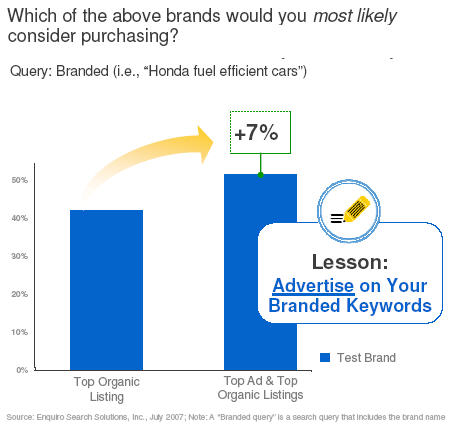
    Now consider the graphic below. Even those who did a branded search (i.e., included a brand in their search query) were 7% more likely to consider purchasing that brand when an ad for it appeared above the brand’s top organic listing. At least, that’s the case when the brand in question is Honda.

    Validation that you should advertise on your brand’s keywords

    This is valuable validation. Other research, most notably from Nielsen Reelresearch, has shown a similar improvement in actually clicks to a site when an organic result and an ad are paired. But it’s hard to spend money on clicks from a paid ad when you have the top organic result for that keyword phrase.

    Say What Counts In Your Text Ad’s Headline and Web Address

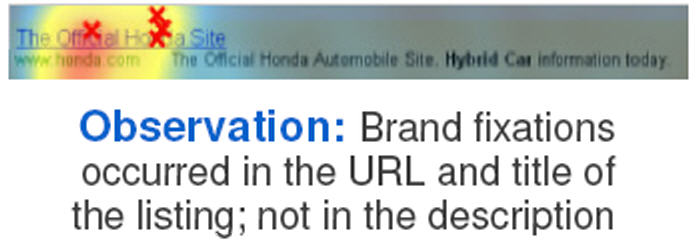
    The eye generally overlooks the body copy, focusing on the text ad’s headline and web addressA final noteworthy finding is based on eye tracking “heat maps” of how consumers read these paid search ads. As the graphic to the right shows, the descriptive copy that follows the headline and precedes the URL barely gets a glance — at least for the typical results page viewer. (Click on the graphic for a zoomed-in view of the heat map.)

    Further research would be helpful. For instance, how do heat maps differ for those who have clicked on the ad versus those who merely looked it over?

    Nonetheless, this research is terrific evidence of the power of paid search, and how best to harness it.

  • Viral campaigns more frequently relying on pre-existing buzz

    Legend has it that in 1936, Lana Turner was playing hooky from Hollywood High School when she was discovered by a film studio executive. She was sipping soda in a local drugstore. Almost immediately, Turner became a star. Social media sites such as YouTube are becoming today’s soda fountain. For example, take the lastest “discovery” (last month there was Nick Haley).

    Musician and University of Minnesota grad student Adam Bahner became a minor internet sensation. Bahner, who records under the name Tay Zonday, wrote and posted a music video that had novelty and a simple but catchy melody going for it. Here is his video on YouTube.

    Next, he is contacted by video production company True Entertainment. Their assignment was to promote a new soda flavor from Dr. Pepper. The director’s vision was to take “Zonday’s” song, add a boatload of production values, and come up with an online video that would get attention and go viral. Very viral. As of this writing, the video has been up on YouTube for exactly one week, and has been viewed there 1,234,763 times. Here it is.

    One of the first lines of the song is “This is the web, and it’s going to murder your TV.” True enough. And it has already made modern Lana Turner stories more sudden, more fleeting, and decidedly digital.

  • In praise of short URLs and one innovative provider

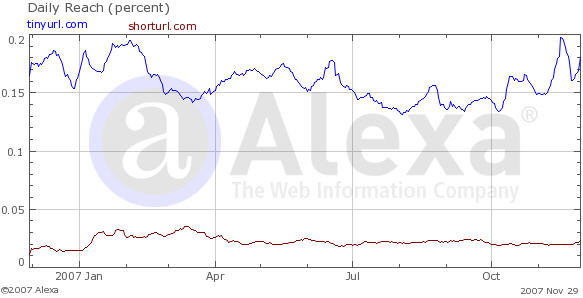
    Like everything else, short URLs follow the rules of supply and demand. My first internet business, in the mid-1990’s, had a four-character dot-com domain name. Back then this was good but not extraordinary. Now the dot-com space is so crowded that many start-ups look like they were named by dipping a spoon into alphabet soup. Luckily there are short URL services — most famously ShortURL.com. [I was thinking of TinyURL.com, the clear winner of the two in terms of Alexa’s Daily Reach metric.]
    These businesses take the sting out of a rangy line of URL characters, while helping to avoid truncation (in emails) and misspellings (when speaking the address over the phone).

    As a market leader, TinyURL offers a ton of features. Maybe too many. An upstart I’ve just learned about (thank you Steve Purkiss of ProjectStars) will give this status quo provider a run for its money. For this month’s One Positive Day, consider what URLao.com is doing right.

    I love URLao’s simple, clean, Web 2.0 interface. They get you started quickly and pull you in with simple explanations of their best features. Here is the language they use for them:

    Private Redirect
    Ensure your privacy by requiring users to enter this password before being taken to the destination.
    Enable Cloaking
    This option hides your target URL — when users visit your link, they will only see your shortened URL in the address bar of the browser.
    Preview Target
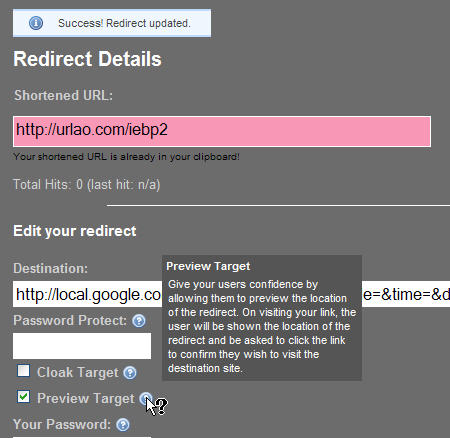
    Give your users confidence by allowing them to preview the location of the redirect. On visiting your link, the user will be shown the location of the redirect and be asked to click the link or to confirm they wish to visit the destination site.

    Notice the number of features is short. Just three. It’s a wise move for an upstart player in this category … promise a simpler yet improved experience.

    Short URL Example (using URLao.com)

    Notice the benefits-heavy descriptions. This is even smarter. I used the last of these features when I created this short, clear URL to go to a Google Maps location of our parent company (and the home of ec-connection): www.URLao.com/FindNS. It’s a shortened version of this ungainly URL:

    http://local.google.com/maps?f=q&hl=en&geocode=&time=&date=&ttype=&q=nelson+ schmidt,+milwaukee,+wi&ie=UTF8&ll=43.043614,-87.899938&spn=0.009158,0.021114 &z=15&iwloc=A&om=1

    There are other features you should investigate, such as tracking each short URL’s use. I’ve often wondered how I could easily track how many people in a short list of email recipients actually click through to the links I’ve provided. This gives me that power, while ensuring that none of the URLs are broken in the process of opening, replying or forwarding the email.

    As with so many other start-ups, this one offers its services for free. That means you definitely do not want to use it for mission-critical work, or anything where online security is an issue. But for quick, smart creation and monitoring of customized URLs, I have yet to find a service better than this one.

  • The power of nuance and why words really do matter on the web

    When redesigning a site for a client, our team works hard to get sign-off on improving content quality — especially the language used. Getting this level of influence is often a challenge. Large sites usually have many content “owners.” In our experience, few of these domain experts are also experts in optimizing online content, either for readers or search engines. These folks can underestimate the importance of nuance to the success of their content.

    Frankly, I don’t blame them.

    Until the advent of the Content Interest Index, there really hasn’t been a way for content managers to gauge success. The best they had were more global, site-wide metrics.

    NOTE: This Tools + Tips post on GrokDotCom provides an excellent run-down of some existing engagement metrics for overall site performance.

    In other words, in the well-worn words of Tom Peters, “You can’t manage what you don’t measure.” Without measurements showing the effect that content quality has on readers, many domain experts overlook the power they wield.

    This is unfortunate. I’ve seen small content changes make impressive differences in response. Here is a quote from the web site of Thom Pharmakis that sums it up well:

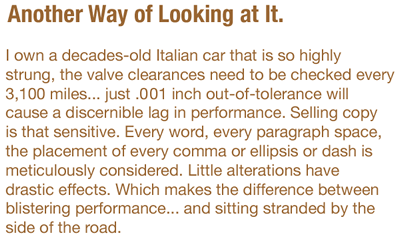
    I own a decades-old Italian car that is so highly strung, the valve clearances need to be checked every 3,100 miles … just .001 inch out-of-tolerance will cause a discernible lag in performance. Selling copy is that sensitive. Every word, every paragraph space, the placement of every comma or ellipsis or dash is meticulously considered. Little alterations have drastic effects. Which makes the difference between blistering performance … and sitting stranded by the side of the road.

    Here, here.

    Another Way by Thom Pharmakis

    As a side note, it takes more than a phenomenally gifted writer to score a bulls-eye on the web. Thom’s statement is displayed on his site as nothing but a graphic (shown above, and found on his site). That means his wonderful metaphor is impossible for search engines to read and index.

    Even when your audience is non-human — and is in this case a search engine robot — it’s not so much what you say but how you say it!