Author: Jeff Larche

  • Social networks and fundraising, Part 2

    Below is a story far more personal and close-to-home than Part 1. This story illustrates how some extraordinary people — including co-workers and friends, but also connections I’ve initiated and fostered on Twitter and Facebook — helped improve and brighten the lives of some of Milwaukee’s under-served. The fundraising took place last month, for an event held Thursday, December 18, 2008, in the basement of a church on the corner of Milwaukee’s 54th Street and Capitol Drive.

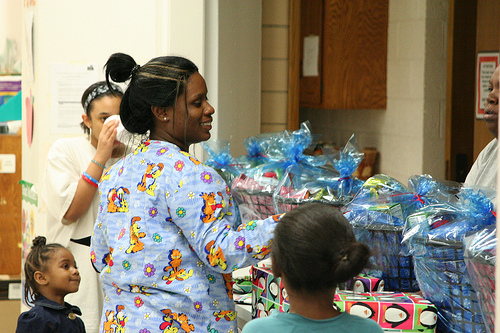
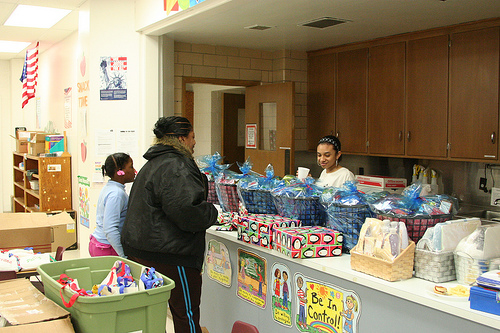
    The slideshow below shows just some of the smiles that this “picture-perfect” night created:

    By way of background, I’d like to quote an email that I sent as part of my fundraising efforts. It explains our pretty ambitious plans for the Winter Holiday Fest. Here it is:

    Hi —

    To those who already know of this, and have contributed or pledged, THANK YOU!!! This is for everyone else:

    My girlfriend and I have devoted a ton of time, and a lot of our own money, to make a holiday party truly special for 68 under-served preschoolers and their families.

    These 4 and 5-year-old children are mostly of single-parent families, and many — if not most — are struggling for the basics, let alone a head start on their school years. For example, in order to qualify, a family of three must have a pre-tax household annual income of less than $18,000.

    So my girlfriend and I have arrayed a small army of volunteers (8, to be precise!) and on December 18, 2008, we’re going to help these families where it counts. There will be a Winter Holiday Festival for them, and Sherry and I are going to:

    • Serve them a meal, since so many parents will be coming right from work: a hot dog, a bag of chips and a holiday cookie
    • Give them an 8″ x 8″ canvas bag with their name on it, containing crayons, pencils, a coloring book and a book mark
    • Set up a decoration station for them to further decorate this canvas bag
    • Set up a cookie decoration station to decorate the ginger bread man they each get (we baked them last night!)
    • Set up a photo booth. I’ll be taking their photos, and placing them in a thin, foam frame
    • This picture frame is then decorated by the kids at yet another station
    • Yet another booth will make “super balls” — a toy they can customize and bring home with them

    I addition, each child will get a pair of knitted winter gloves and a fleece scarf — also labeled with their names on them, so they don’t get misplaced in the classroom.

    Also, we are raffling off as many $20 baskets as we can afford, filled with flour, pancake mix, syrup, peanut butter, jelly, etc. — you get the idea. These are staples that the parents can use over the holiday and into the new year, along with some treats, such as two mugs with hot cocoa mix.

    The only financial support we’re getting is from donations of people like you. Each $20 donation we receive will purchase one more basket of food, or other necessary supplies for the event.

    Can you please pledge twenty bucks to this worthy cause? (Thanks, Nelie, for your $20 “seed money,” and to everyone else who has donated on this).

    PLEASE HIT REPLY and say yes. Yes, I take checks … and IOUs! 😉

    If you have other holiday charities, or other reason not to give, God bless you. But if you don’t, Sherry and I and the rest of the team will be supplying photos of the many happy memories that you will have helped to create.

    Please say yes. Right now. THANK YOU!!!!!!!!!!!!!!!!!!!!!

    ~Jeff

    This and other efforts raised an impressive sum (including the money to cover other supplies, the amount came to $628). We were able to raffle off enough holiday baskets to make a lot of parents very happy indeed.

    The Gift Basket Were A Huge Hit

    Speaking of the baskets, I was a little astonished at the response. You would have thought we were giving away new cars!
    Social Networks and Fundraising

    Examples like TweetsGiving have demonstrated the power of social networks to get out the word. By contrast, this story shows more of the power of grassroots fundraising. Physical networks were leaned on heavily — especially my relationship with workmates at ec-connection, Nelson Schmidt and Madison’s Waldbillig & Besteman.

    That said, you might have guessed that I “put the touch” on many of my closest online friends. Our fund raising tally was definitely boosted by my online network, including two of my newest friends. (@annNow and @ChrisQuick, you know who you are!)

    For all of those who contributed, I want to say that I and the other volunteers (Shannon Schlintz, Jaime Schlintz, Paul Thomas, Noel Stollmack, Barb Lloyd, and event mastermind Sherry Richards) could not have done it without you.

    And for those of you who are considering social networks as part of your fundraising efforts, rest assured that this and the case mentioned in Part 1 illustrate how, especially when your network is strong, you can accomplish amazing things!


  • Social networks and fundraising, Part 1

    Shortly before Thanksgiving, a post on Twitter asked me and others on this friend’s network of “tweets” to consider helping in the building of a classroom in an African village. The link that was embedded in the tweet provided the details necessary to authenticate the appeal, and five minutes and one Paypal transaction later, I was back to work.

    I was not alone.

    The graphic below shows the pace of giving for this campaign, which successfully raised more than $10,000.

    tweetsgiving_donations_by_day

    More information on the campaign can be found at the Tweetsgiving web site, and in this post about the project, written as it was underway.

    tweetsgiving_postscript

    The success of this project should not be misinterpreted, however.

    It would be easy to conclude that this illustrates the marketing reach and power of a new medium. Yes, it’s true that this “medium” is powerful. But as others have pointed out, it would be like saying the telephone is a powerful medium, because so much business is transacted over it.

    Instead, we have to look at social networking as a new way of communication. Period.

    And as long as the means of communication is handled well and for a compelling reason, exciting things can be built — a brand, a reputation … and even a classroom inTanzania.

  • Online display ads prompt more searches and lift conversions

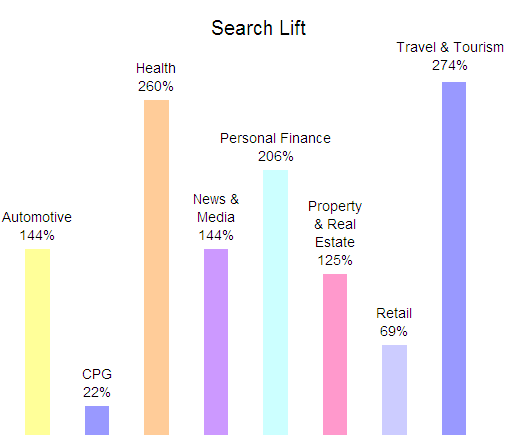
    A recent study reported in eMarketer (results graphic below) shows a surprising boost in organic searches when consumers are exposed to an online display ad.

    What is especially interesting is the variation by industry:

    lift_from_ads
    The improvement in number of searches when consumers see a display ad

    (Could it be that display ads in certain industries are more effective than others? I’m guessing that’s at least part of it.)

    Obviously, the real test of a display ad is not its effectiveness at spurring interest (i.e., a search), but at making a sale. It turns out the lift in coversions of combining display ads with paid search is significant as well. In a prior study by Microsoft and Atlas DMT, reported in this Clickz article, it was found that overall conversions when search and display ads were used simultaneously was 22%.

    What is significant about this study, however, is for some categories of business there was no lift in conversions whatsoever.

    The fact that conversion rates improve at all is good news for online advertising. In fact, the eMarketer piece concludes with a prediction for this harrowing new year:

    Search and display ads will retain the highest share of online ad spending formats through 2013, and will be the only formats to maintain double-digit share through that period.

    It will be interesting to watch.

  • Thrive in this down market by finding and catering to social customers

    Database marketing consultant Kevin Hillstrom has done impressive work in helping retailers trace their customers across sales channels, using Multichannel Forensics (Note: this link is to a PDF file). Now he’s helping clients — and blog readers like me — to find creative ways to re-segment customer files based on responsiveness in a Web 2.0 world.

    NOTE: Click for larger image

    In his post, Kevin lists five segments of customers. Three are familiar: Organic (those customers who are your without a traceable stimulus, such as advertising), Advertising (they’ve purchased because of a non-discount-related ad) and Begging (you’ve given them discounts and other strong incentives).

    Two are new to the Web 2.0 world, and thinking about them is a valuable exercise. They are Algorithmic and Social customers. Here is his description:

    Then we have customers who use algorithms to purchase. Yup, these are the customers who use tools like paid search to purchase merchandise. These customers are different. They don’t always respond to future advertising, and when they do respond, they combine advertising and algorithms to make decisions. This is where your Net Google Score comes into play. Catalog brands really struggle with algorithm customers, and online marketers struggle with e-mail marketing programs for algorithm customers.

    Increasingly, we find ourselves managing social customers. If you’re Crutchfield, you have customers who buy merchandise, customers who write reviews, and customers who are referred from blogs to your site. The latter two groups represent “social customers”. Social customers are different than are typical catalog customers, and are different than typical e-commerce customers.

    These two segments describe a type of purchasing behavior that is brand new. Especially the Social customers.

    Hillstrom goes on to say this about Social customers:

    Catalogers are way behind the curve when it comes to managing social customers. In fact, almost everybody is behind the curve regarding social customers. Hint: Social customers don’t necessarily embrace catalogs, and sometimes get really angry when [you fill their] mailbox.

    Smart catalog marketers are hyper-sensitive to the nature of their customer conversations. Even if you’re not in the catalog retail business, you should be too.

    Here are two examples:

    1. When people arrive at your site from an organic search, greet them with the phrase they searched for (when it is a relevant phrase) and offer several links that can help them better find what they’re seeking. Then trace them to a conversion and compare to a control that receives no greeting.
    2. When people arrive from a social site, watch where they go within your site. For statistically significant instances (lots of page views, subscriptions to e-newsletters, etc.), consider making a friendly, overt presence on that social network (remember these 11 magic words when posting any social media comments).

    Other ideas will come to you when you realize the obvious: The source of a customer changes that customer’s future buying behavior.

  • The new power to get in: Twitter

    A decade ago Michael A. Boylan wrote a book on business to business (b-to-b) selling called The Power to Get In. It was publicized as “a step-by-step system to get in anyone’s door.” To reiterate the book’s promise of granting access, Boylan begins Chapter 1 with this pronouncement: “You’ve been frozen out.”

    It’s a terrible feeling, and familiar to many who have something valuable to sell but cannot seem to get an audience with the proper buyers.

    A case for Twitter for business

    I’m not a sales coach, but I have personally seen that when you apply the Golden Rule (Do unto others as you would have them do unto you) to Twitter, it can help you succeed. It may even help you regain that Power to Get In.

    Here’s why people get “frozen out”: In the business world, we’re all overloaded with too many people who want a piece of us. This has a key driver behind the drop in responsiveness of these tried-and-tested lead-generation techniques:

    • Email open rates and click-throughs are falling
    • Direct mail is becoming more expensive and less effective
    • Phone calls, with their deadly voice mail phone screeners, aren’t being returned

    Viewed 20 years ago, the solution would have been to learn to play golf. And that method is still viable today, for reasons I’ll get into in a moment.

    But in the meantime, social media are providing quasi-business environments, most notably Facebook and Twitter. In both cases, these systems use a social phenomenon that’s come to be known as ambient awareness (here’s an excellent article on ambient awareness by Clive Thompson of The New York Times).

    The growth of these seeming “distractions” (okay, real distractions), is two-fold.

    1. Drinking from a fire hose

    First, we are all overwhelmed. To use the famous metaphor, we are trying our best to drink from a fire hose of information. This was described wonderfully in the book The Paradox of Choice: Why More Is Less. For those who are inclined to try it, Twitter (and Facebook “mini-feeds”) can be a way to control this information flow. It’s like creating our own private channel of friends and business associates, available in real-time whenever we’re ready to check it out.

    2. Special access to a private gathering

    These micro-blogs allow us to grant special access. Remember when only a handful of your best friends and business colleagues would get your email address? Well, now your many email addresses are teeming with responsibilities and requests. Even our most private email accounts can become another obligation to maintain.

    Relative silence, plenty of fresh air, and interesting challenges

    Most humans who have been working at their computers much of the time yearn to be surrounded by friends and interesting colleagues, with few distractions. At one time, it was joining a country club that scratched that itch. Twitter is starting to do the same.

    And because it is attracting some significant decision-makers, it is taking on some of the same appeals, in terms of lead generation, that golf does.

    Ostensibly, golf is a game. But playing with potential business partners offers surprising access, and an informal context for the discussion of mutually beneficial opportunities. So golf is no mere game. The ambient awareness mechanism of Twitter offers the same lead-generation potential — if it is used properly.

    The three rules to using Twitter for business

    Follow these three rules and you cannot go wrong:

    1. Like other networking, think about helping others before yourself. Look for chances to respond to other people’s queries or interests
    2. Find chances to meet face-to-face. Here’s the story of my awakening to the potential in a “Tweet-up.”
    3. Never or rarely directly promote what you’re selling

    Sign up for a free account on Twitter. Follow me if you’d like; I’m at @TheLarch. And then begin exploring a surprisingly productive business time-waster. Perhaps even as productive a time-waster as golf!