Month: October 2026

  • Competing at Machine Speed: A Book Review

    Competing at Machine Speed: A Book Review

    I just read a book that describes an important use case for AI automation. If you work in the marketing of enterprise brands, you should read it too. 

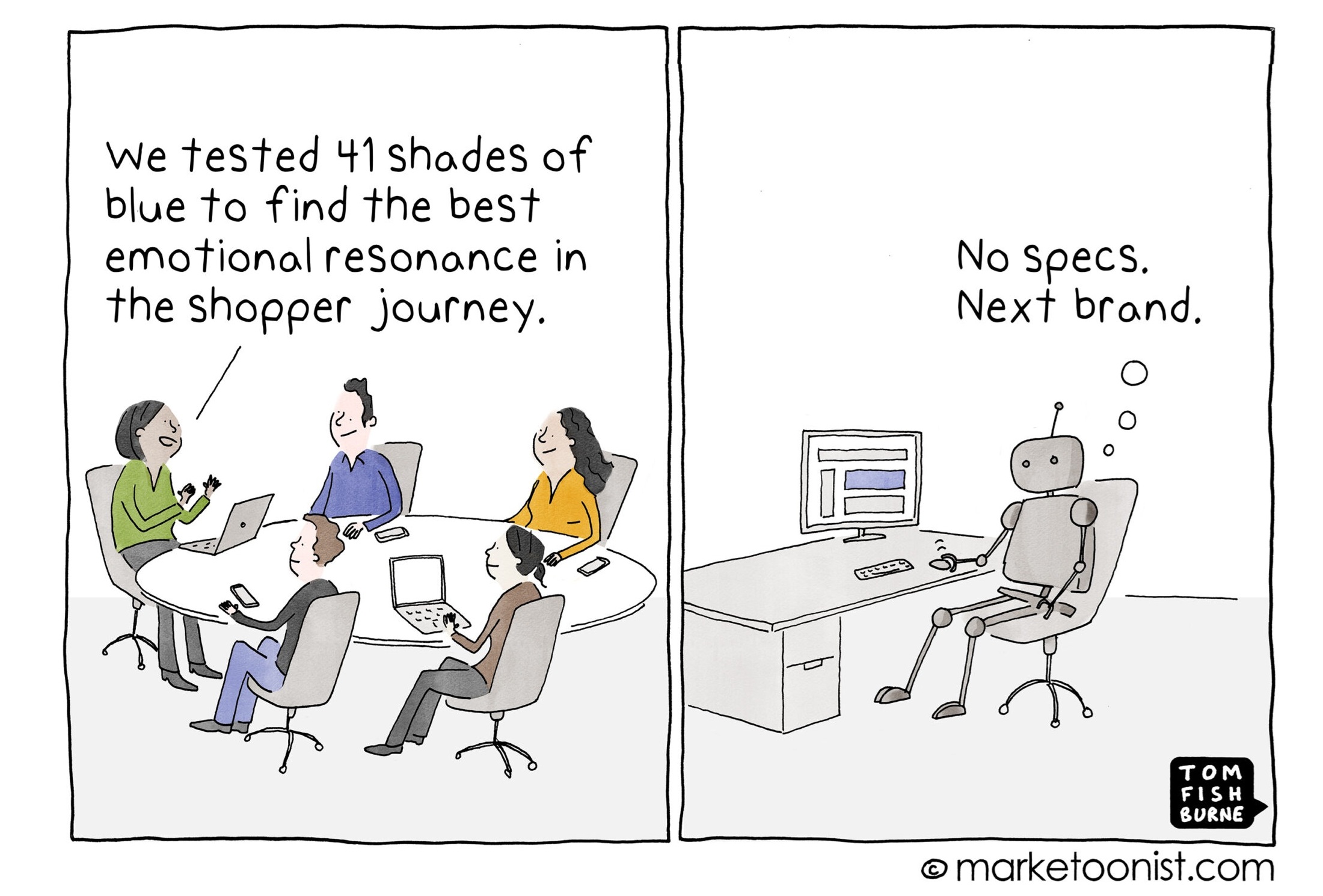
    I’ve licensed the above cartoon because it aptly reflects a major challenge facing brands in an increasingly complex shopping environment. Today product description pages (PDPs) need to serve two masters: The humans who shop for a product, and the AI agents shopping on those humans’ behalf. Agents like Meta’s Muse1, a new assistant whose app was downloaded 5 million times in its first three weeks.
    Muse and other agents don’t care about carefully crafted packaging, emotional storytelling, or brand heritage. They want one thing: product facts … and plenty of them. Marketers who don’t do that work — inserting those facts into PDP data schemas — are doomed to lose progressively more share to upstart competitors who do.

    It’s only one of the challenges facing enterprise brands that are explored in the opening chapters of Competing at Machine Speed. That section delves deeply into a daunting list of brand marketing headwinds, using many real world examples. Notably, the book describes the emergence of new, post-pandemic battlegrounds where brand sales are won and lost: the retail sites. 

    Each major retail platform (Amazon, Walmart, Target, Kroger, Instacart, Albertsons, and the rest) runs its own proprietary algorithm for determining where products appear in search results, which sponsored placements convert best, and which content signals it uses to judge a product’s relevance and quality. Those algorithms are not published. They are inferred from performance data, industry reporting, and trial and error. And they change.

    That last sentence is key, because changed requirements by the platform must be addressed quickly just to maintain placement prominence. 

    Before these retail sites emerged, the marketing of your product was simpler. You promoted the product and ensured physical store shelves were stocked. Yes, there were competitors in your category on those same shelves, but their number was physically limited. You could adjust your advertising to elevate your comparative primacy and make the sale.

    Of course you still need to do that. But today important retail sites have their own “shelves”: the product listing pages (PLPs). And because of long-tail economics, the platforms have an incentive to include in their PLPs and search landing pages as many competing brands as meet their low cost of entry — dozens or more of them, all vying for your customer.

    This has turned selling on retail platforms into ruthless cage matches. Bidding determines which brand gets primacy on PLPs. The auctions erode margins and can even exert downward pricing pressures. Add to that the fact that you can see your prized brand demoted because of changed requirements I mentioned above. Those must be addressed, and often are not in a timely manner, because you and your colleagues are busy making similar changes for higher priority brands in the portfolio.

    A challenger brand with one hundred SKUs and a team focused entirely on its digital shelf can manage every product with the intensity a major brand reserves for its top 10%. Its Long Tail does not exist. Its entire portfolio is the Head.

    Competing at Machine Speed

    The primary way to win these cage matches is automation. That is the agentic use case the rest of the book covers.

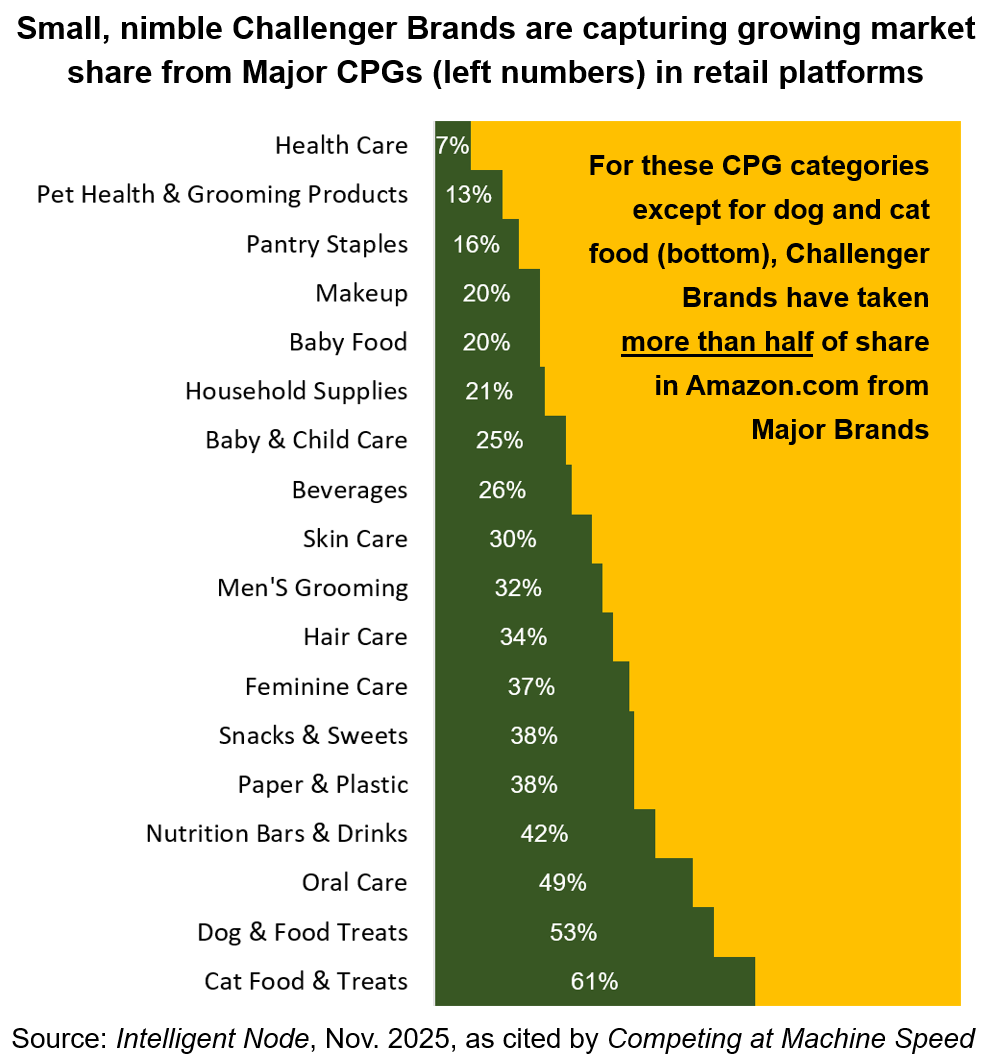
    Change of this magnitude is hard, especially in an enterprise with many layers of oversight and governance. The authors knew it will take a lot to persuade the C-Suite. That’s why the book presents, near the end of that first section, ample evidence of small, nimble challengers “swarming” most brands, in most categories, and stealing their market share today. 

    Challengers use their small size as an advantage. Industry metrics show they are succeeding:
    Beating the challengers at machine speed

    The book’s solution — the bulk of the book — is to employ agents that “think” like start-ups, meeting challengers where they live:

    The swarm’s advantage is structural, not strategic. It is the advantage of being small, having little to protect while attacking everything.

    What changes the calculus entirely is when the incumbent builds a system that matches the swarm’s operational speed while applying the advantages that only the incumbent has: the brand equity, the category expertise, the retailer relationships, the consumer trust built across decades, the capital to invest at scale. The swarm can replicate keywords. It cannot replicate twenty years of consumer loyalty and clinical investment. What it can do, and is doing, is render those assets invisible by competing in an environment where the [incumbent] brand cannot show up consistently.

    The system architecture described is detailed and comprehensive. So much so that the book’s text can be used to align enterprise LLMs on how to organize themselves and get to work.

    I don’t want to give too much away, because you really do need to buy the book and study their proposed architecture first-hand. But one thing I want to emphasize is that this agentic use case is not a strategy for shedding headcount:

    This is not about replacing the humans on the commerce team. It is about reassigning them to work that their intelligence is suited for. The category manager who spent 40% of their week pulling data and updating reports can now spend that 40% developing the commercial strategy that the agents then execute. That is the shift the system enables. Operators become Orchestrators.

    Two of the authors are work friends of mine, esteemed colleagues from my tenure at Accenture. But I have no financial or personal stake in endorsing this book. You should keep that in mind when I tell you that this book blew me away. I’m confident it will become a business category best-seller. 

    If you’re a marketer at an enterprise brand, you need to understand how to meet today’s challenges. This book gives you the blueprint. Whether you’re a CMO, category manager, or digital strategist, it will fundamentally change how you think about your role in the commerce chain.


    1As of this posting, Amazon is blocking Meta’s agent. This may change. In my opinion it will, when Meta works out with Amazon ways to compensate for the likely loss of income from the leapfrogging of Amazon’s profitable Marketplace ecosystem.


  • Video killed the podcast star

    Video killed the podcast star

    In 1981 the inaugural MTV music video was Video Killed the Radio Star; Today social media videos are similarly changing podcast economics

    Then and now, it was about media economics. History has shown us how radio, a favorite medium of mine since I was a kid in a remote rural town, lost much of its ad dominance to television, and then further to cable TV.

    Then came podcasts. To me they were a revelation! They were radio, but with topics scaled across what felt like an infinitely long tail — far more variety and specificity than broadcast or cable bandwidths could ever deliver.

    And, Bonus! They were on demand, so I could listen on my terms! 

    Back in its infancy, podcasting was like a specific type of audio: college radio. In that there was zero money in it.

    I mused on this very site, 20 years ago, how podcasts might change that. I even predicted in Monetizing podcasts that we could have ad buys and sponsorships as the drivers of its business model. Of course what I couldn’t predict back in 2006 was socially-distributed videos and clips — which have knocked out of our ears the voices of, to name three, Dana Stevens, Stephen Metcalf, and Mike Pesca.

    Below you’ll learn from Mike why his voice, and possibly others, are no longer in our podcast feeds. You’ll also get a prediction for how video podcasts may themselves be facing a pivot, postulated by Ryan Broderick, the man behind the excellent Garbage Day newsletter.

    Podcast promotional clips eat their masters

    July of this year was not a happy time for me in terms of my media diet. First, Slate Culture Gabfest shut down after 18 years. And after 16 years, Mike Pesca’s The Gist met the same fate. Although I haven’t learned a reason for why the former podcast folded, Pesca was forthcoming about his, in a conversation about current podcast economics. The TL;DR in one word: Algorithms:

    The co-host of Scott Galloway’s Prof G podcast, [Ed Elson], put out a social media clip, saying “Our clips are not only much more seen than the show. They’ve essentially become the show, when people think about who’s Scott Galloway and me, the sidekick. They only think about the clips on social media.” 

    So [the business model] has become inverted. Rather than having promotional materials for the show, the show becomes in service of these promotional materials. It is solely a vehicle to cut social media clips. [Ed was saying the clips were also] a major if not main way that the show made money: The promotional material about the show. And … if I started to do these social media clips, which I tried, and if somehow I got good at it and I was making a ton of money at it, I might say all right, I’ll lean into that. But that was never the case.

    One bright spot for me personally was that before The Gist shut down, I got my question answered on a long-standing segment of the show, called Is That Bullsh*t? You can listen to the 14-minute excerpt below:

    Is This Current Pivot To Video Finally Ending?

    That was a subheading in a recent Garbage Day newsletter. Ryan Broderick gives his reasoning for why he thinks the answer is Yes:

    • YouTube has drastically changed what their front-facing metrics track — but not what they pay for you! Basically, opening a YouTube video now counts as a view, even though they’re still only paying you for “engaged views.” 
    • MS Now will soon be airing Crooked Media “podcasts,” which are really just talk shows. YouTube channels are simulcasting on Netflix. 
    • And I’m hearing from a lot of short-form creators lately that that entire realm is basically over if you want to make any real money.

    “As for what’s next, my prediction is a complete hollowing out of the video middle class, as it were. Professionally produced studio shows and random people talking into their phones and basically nothing in between.”

    Time will tell. If it does, maybe on-demand audio, the “theater of the mind,” will experience an economic resurgence.

  • Hey TikTok, where is my check for inventing the metric that powers you?

    Hey TikTok, where is my check for inventing the metric that powers you?

    A spooky tale about a dead metric rising from the grave to take over the world

    This 2010 blog post of mine, Content Interest Index is the “missing link” in web analytics, outlined a novel metric that fills a measurement gap in a sales journey. Six years later, TikTok was launched with an algorithm that preforms precisely this measurement. And does it brilliantly. Here’s the story of my quest, and what it teaches us about finding and filling innovation gaps.

    I outlined the business case in an earlier post. It described why Content Interest Index (CII) needed to be invented:

    The first marketing class I ever had in college taught me the AIDA model of advertising. It’s still used today, lo these many years later. The AIDA model goes like this: [To make a sale,] once you attract Attention, you must generate Interest, create Desire, and enable your market to take Action. Do all of those things and you’re golden.

    Back then the only way you could actually measure any of these (except for the last A, which was making a sale) was by employing expensive and time-consuming research. The web changed all that. It allows us to measure each of these steps — except for that pesky thing called Interest.

    When I posted that I was leading a team of web developers. Using Google Analytics 1.0, I added client-side instrumentation to measure proxies for the interest levels of visitors in the pages of a financial institution’s website. Those proxies included how many people shared a page, bookmarked it (a thing back then), or sent it to PDF for printing. 

    With those behavioral proxies we hoped to calculate the comparative “interestingness” of this client’s content. Unfortunately our contract expired and I was never able to analyze the results and calculate the likelihood of CII to predict entering a conversion funnel (Desire) and achieving an online conversation (Action).

    I soon moved on from that agency, and also concluded the client-side instrumentation available at the time would never provide enough of a signal to be useful. I considered CII a dead metric.

    Then came TikTok.

    The breakthrough of ByteDance was using newer, real-time technology to create an app that leveraged its own proxies for interest, and prioritized them in a scoring model that could revise itself in milliseconds.

    According to this Wall Street Journal investigation into TikTok’s secret — and extremely addictive — algorithm, the app prioritizes engagement signals including likes, follows, and watch time. Most notably, “We found that TikTok only needs one of these to figure you out: How long you linger over a piece of content.”

    They found what many of us have experienced firsthand: Within minutes of lingering even slightly longer on a particular video type, TikTok adjusts your feed to show more similar content.

    This methodology became a blueprint. Meta adopted similar interest-duration models, and within years, interest measurement became the industry standard. In January, TikTok formalized its U.S. operations with an investment group, valuing the platform at approximately $14B USD, a vindication of the algorithm’s effectiveness.

    The Takeaway for You: The AIDA model had a digital analytics blind spot, and for years, we couldn’t find a way to fill it. Rather than accepting that limitation, I tried to bridge the gap.

    You likely face similar blind spots in your current behavioral analytics work: metrics you can’t measure, customer signals you can’t track, or questions your tools can’t answer. That gap is where innovation lives. When you find it — and have the persistence to investigate — you may be creating the next industry-standard metric.