Month: May 2007

  • What I learned from my Twitter experiment

    Two weeks ago, at the end of my latest post exclusively about Twitter, I announced that I would let you know the outcome of a little two-week test. In it, I temporarily opened my “Tweets” to the world, so to speak. My posts became part of the Public Timeline of Twitter posts. In that time I’ve continued to enjoy what I like about Twitter: Being able to keep in touch with friends who are on it. But I have to say the foray into the public conversation didn’t amount to much more than that.

    I didn’t know what to expect, but here were a couple things that I considered possibilities:

    1. Some people might pick up on references to my more provocative blog entries (such as this one, about mobile communication and the Virginia Tech shootings) and respond directly through Twitter
    2. Others would actually click through to those entries, using URLs that I inserted in the Tweets, and possibly even comment on the blog entry

    Someday this might happen for someone. Neither did for me. I suspect that my Tweets were too diffused among the millions of others. Without a way for users to filter by preferences or topics, my Twitter posts became a few needles in an ever-growing haystack. Without context, these “microblog posts” zoomed past and faded without incident.

    Well, almost. The day after I began the experience, I received the following:

    • My one and only visit to this blog that I can directly trace as a click-through from the Twitter public timeline (sheesh!)
    • A single message from an “admirer” of my golden (albeit truncated) prose: A spammer trying to get me to visit his site where he was selling something (Does my prose look like I need Viagra?)

    It’s not that I was expecting the sort of bank run that Digg.com got when its users started posting an illegal DVD unlock code. But I was hoping for something of interest.

    Especially, I was wondering if I could expand my online social network, as I have recently with activities in LinkedIn. I’ll be writing more about LinkedIn in a future post. As for Twitter, starting today I’ll be henceforth mum on the topic.

    If you want to reach out to me in a public network, you’ll just have to join my growing — and quite interesting — LinkedIn connections list. Here is my Profile: http://www.linkedin.com/in/jefflarche

    Postscript: I just went on the Public Timeline and was astonished to see a friend’s Tweet: Way to go, Jazyfko! I hope your cold is getting better.


    Update on May 26, 2007: One of the more promising applications of Twitter so far is the recently launched Truemors, the latest start-up by Guy Kowasaki.


  • Name-googling matters in business, even for execs still in the womb

    A term made popular in the 1990s was You, Inc. As we travel through our careers, each of us needs to think of ourselves as brands. These individual brands are like product brands. They have names and reputations, to be nurtured and merchandised. Two recent stories from the Wall Street Journal (WSJ) remind us of the new power of our personal brand names in a world where Google has become a verb, as in “to google.”

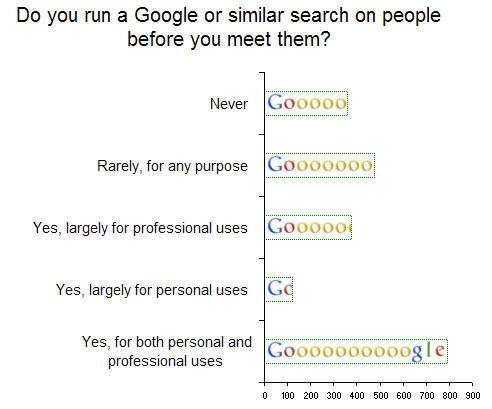
    The first story talks about how often executives do search engine research on business contacts before they meet them. You may be surprised that more than a third of those surveyed by the WSJ (37%) said yes, they google people for “both personal and professional uses.” Another 18% said yes, but largely for business purposes. Taken together, half of all of the 2,118 executives surveyed use search engines to check out business contacts.

     More than half of those surveyed use search engines to check out business contacts

    The other WSJ story makes sense in this perspective, because it describes how many expectant parents are choosing the names of their unborn babies based in part on the name’s lack of competition in search engine results. As the title of this article suggests, You’re Nobody Unless Your Name Googles Well.

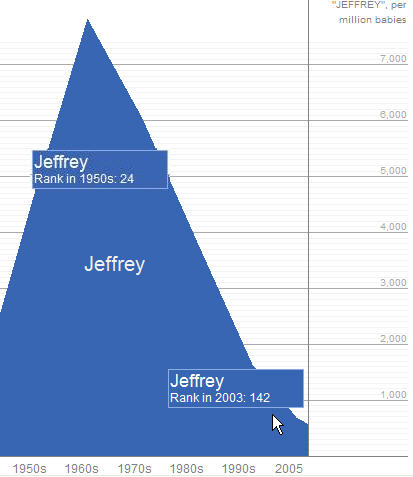
    As a side note, I was humbled at what a flash-in-the-pan my first name has been when you see its popularity charted over the decades. Check out this fun iVillage Baby Name Wizard to see how your name has held up over time.

     Are you expecting a baby? PLEEEASE name him Jeffrey!

  • Mix bad movies and funny commentaries to create the first truly profitable podcasts

    It’s been almost a year since I marveled over the ingenuity of director Kevin Smith. As part of the theatrical release of his movie Clerks II, Smith released a free director’s commentary on iTunes, in Podcast form.* Back then I called it a smart way to get his core audience back in the theaters. I considered it one of the most innovative ways yet to monetize the podcast. Television comedian Mike Nelson has taken a more direct approach. He has created what I can only describe as the first ever movie/podcast mash-up. And it promises to make him and his partners rich.

    The mash-up, which was first coined to describe what DJs create when they mix extremely divergent musical tracks, has moved to the “Web 2.0 blending” of different programs, such as Google Maps and Craigslist in this real estate mash-up. Now, with RiffTrax, Mike Nelson and his fellow satirists are creating podcasts that you can buy and blend in your living room, with the DVD they are lambasting.

    Think of a RiffTrax podcast as a commentary track, as you’d find on a DVD, featuring the director and a few actors, and maybe the script writer. Now imagine the film they’re talking over (as in a voice-over) is worthy of ridicule, and all parties are very witty and have been injected with sodium pentathol to loosen their tongues.

    Okay, that’s not very helpful analogy. Actually, what could help me explain this idea is if you, like me, were a fan of the long-running, now-defunct Mystery Science Theater 3000 television show. That’s because most of the RiffTrax cast members are from that show.

    A low-budget, low-margin production, Mystery Science Theater 3000 (lovingly known as MST3K to fans) never made Nelson or his cohorts much money. RiffTrax is also low-budget, but selling for $.99 to $3.99 each, these podcasts will become very profitable very quickly. I also admire the fact that the venture side-steps any copyright problems, because of its do-it-yourself nature. You must download them to your MP3-player, and play them on a stereo, simultaneous to viewing the movie. You make the mash-up, not them. Brilliant.

    I was incorrect a year ago when I predicted that Kevin Smith would sell a lot more popcorn by driving his audiences back to the theaters, earbuds firmly in place, to listen to his commentary as they watch the film for a second time. So you’d think I would be a little less free with my wild predictions. But hey, I know MST3K fans. Heck, I am one.

    Fans like me will try this, and some will get hooked. Just as happened with the series, RiffTrax will inspire parties, formed around televisions in dorm rooms and family rooms across America. Word will spread, and this Long Tail sensation will become a mainstay for those with a wide streak of geek and a taste for droll humor — mostly G-rated at that.

    RiffTrax will deliver the Holy Grail: A truly profitable podcast. It will also spur spin-offs, to appeal to other niches, such as satires to popular television series, now on DVD. But that’s well down the road. As for the short term, I can only say with certainty that my first RiffTrax party will take place within weeks.


    * A half-century before the inventiveness of Kevin Smith, William Castle found similar ways to add new dimensions to the film-going experience, in the cheapie thrillers he cranked out. For instance, for The Tingler, Castle placed electric buzzers under theater seats, and zapped people’s butts during scenes where the audience was supposed to jump in horror. I’m sure it produced screams, but directors of the time, like Alfred Hitchcock, were using less convoluted techniques.

  • Could their cell phones have saved the Virginia Tech students?

    In a few weeks I’ll be giving a speech to a group of university and college marketing professionals. The topic: Our changing communication landscape. I plan to focus on that word — communication — instead of marketing. Modern marketing is increasingly about simple, authentic communication. Especially when your audience is part of the Facebook and AIM generation. What follows is the introduction I am considering for my talk.


    Just as ClickZ Experts columnist Sean Carton did in his blog entry on this topic, let me begin with a disclaimer. No blame for the Virginia Tech tragedy should be laid at the feet of the school’s administration. None. It is clear they did everything by the book, following the existing protocols pretty much to the letter.

    Events played a horrific trick on these school and law enforcement officials. Once they realized that the shooter in the first pair of murders was on a rampage, the challenge of alerting students was daunting. Alerts were sent by email. Most went unread when they could have done the most good — immediately upon sending.

    Cell phone SMS – also known as text messages — would have better matched the message with the audience.

    Choosing the right medium for your message is really Communications 101. But habitual thinking can blind us to the newest, best ways to communicate. Then something terrible comes along to wake us up.

    I’m using the example of Virginia Tech to remind us all that we need to forge new habits if we want to succeed, whether our job is to keep students safe, or attract them to our schools in the first place.

    In a recent blog entry about Twitter, which is a way to push messages en mass to friends’ cell phones, I had mentioned that some of the last messages passed between loved ones during the fires of 9/11 were via SMS. Even when the electricity and land lines were down and cell phone circuits were jammed by too much traffic, the thin pipeline of SMS over cell phones and PDAs remained clear. Messages continued to pass in and out of the Twin Towers, in 160-character packets, presumably until the heat and smoke was too great.

    I suggested in that post that had Twitter existed then, its SMS abilities might have passed emergency information to a critical mass of people on the imperiled floors, informing them that help was not on the way and the stairways were the last, best chance at survival.

    Similarly, text messages to the students at Virginia Tech could have instantly carried enough information to enough students to help them avoid or escape harm’s way.

    No company can say they are fortunate because of a terrible event, but the publicity from the shootings has boosted exposure for Rave Guardian, a technology by Rave Wireless that allows students to opt in for the sort of vigilant tab-keeping that was once the exclusive domain of worried parents.

    Rave Guardian allows students to set a timer — for perhaps 30 minutes — when they leave their friends’ dorm rooms to go back to their own. If they return safely they can simply turn off the alarm.

    “If something did happen, it would transmit their location every three minutes, including their profile, to campus safety,” reports Rodger Desai, president and CEO of the company.

    This is just one application. Rave, like many others, has recognized that although the web and email have their uses, modern students use their computers less often than their cell phones. They are field-testing a set of channels that students can set up to receive everything from bus schedules to campus news. A freshman at one of the pilot schools, Montclair State University, said that he gets a ton of value out of his cell phone by using these channels, including the following:

    • Checking out the menu of his dorm’s dining hall
    • Monitoring a continually updated map showing the progress of shuttle buses in their routes through campus

    “It’s pretty useful, and it’s going to get better and better,” this student reports.

    I agree. Now information coming to cell phones is but a trickle. But there will eventually be a potential torrent — one that is thankful regulated by a faucet we control at an individual level. This will happen. And in this country at least, it will happen first on our high school and college campuses.

    So let’s all of us vow now, as the parents, grandparents and stewards of the kids who will be blazing this trail, to do our best to at least watch where they are going. Lord knows we may not understand it all, but we could understand enough to help them become educated, productive citizens. We may even have a hand at saving someone’s life.

  • Ogilvy on web advertising

    My alternate headline for this post is: Winning web headlines can be long, but watch your column widths. Here’s why …

    Ogilvy On AdvertisingThe book that first inspired me to get into direct response — a move that led directly to my love of interactive marketing — was written by a famous ad man. Remarkably, David Ogilvy’s Ogilvy on Advertising is still in print. More remarkable is how much of his advice on successful direct marketing, print and television ads is still relevant. And directly transferable to the web.

    I was thinking of him again today when I was in a design meeting where one of our web designers was counseling against an overly wide column of text. He said, “We don’t want this column to span more that 400 characters. More than that fatigues the reader.” Wow, I thought. This advice is almost verbatim from a book that predates the web as we know it by at least 10 years.

    Headlines are another source of attention — and often misunderstanding. Although headlines linking to web pages can be short and still be effective, they should be long enough to get the job done. Abe Lincoln, when asked how long a soldier’s legs should be, was said to have answered, “Long enough to reach the ground.”

    I’ve learned a lot by following the advice of the excellent Brian Clark, in his CopyBlogger. He periodically singles out strong headlines, based on his experience in the business. (And thanks again, Brian, for citing one of mine). His criteria remind me a great deal of Ogilvy’s, which was based on some of the deepest readership research done at the time for advertising. Here is Ogilvy’s take on the headline:

    [Our research] reports that [print] headlines with more than 10 words get less readership than short headlines. On the other hand, a study of retail ads found that headlines of 10 words sell more than short headlines. Conclusion: If you need a long headline, go ahead and write one.

    Other tidbits of his that apply to online headlines and links include the following:

    • Headlines containing news are “surefire” — they are recalled by 22% more people than ads without news (and lots of pay-per-click research shows that they generate more clicks)
    • Never use all capital letters — they’re less readable in both print and online. And with the web, people may think you’re shouting, to cite the classic email netiquette tip
    • Whenever possible, promise a benefit

    So what is the longest character count we counsel for headlines? Keep them to 75. It’s the standard set by Digg for their listing’s headlines. And this number is just a few characters greater than the number that is indexed by Google (according to lore and legend) when Google’s spiders read a page’s Title tag.

    Which brings up an argument in favor of the longer headline that Ogilvy couldn’t have anticipated. Length improves the chances of including a keyword that will move your page higher in search engine results pages. That’s the sort of down-and-dirty selling tactic that the late Mr. Ogilvy would have loved.