Networks are personalizing our sense of place after depersonalizing time

Written by Jeff Larche on July 31, 2007 – 2:53 pm -

There was yet another piece in the New York Times last week about the disintermediation of established businesses as a result of our new, networked world. In this case, it was about how new map mash-ups are growing in popularity, to the chagrin of many professional cartographers. Here’s an excerpt:

With the help of simple tools introduced by Internet companies recently, millions of people are trying their hand at cartography, drawing on digital maps and annotating them with text, images, sound and videos.

In the process, they are reshaping the world of map-making and collectively creating a new kind of atlas that is likely to be both richer and messier than any other.

They are also turning the Web into a medium where maps will play a more central role in how information is organized and found.

Initially, I thought this article was further proof that networks automatically disintermediate. It’s just their nature. They cut out that faceless “middleman,” whether this “man” is a travel agent, a realtor, or — in the case of Wikipedia — a traditional encyclopedia editor. But then I heard a story that showed me how networks can cut both ways.
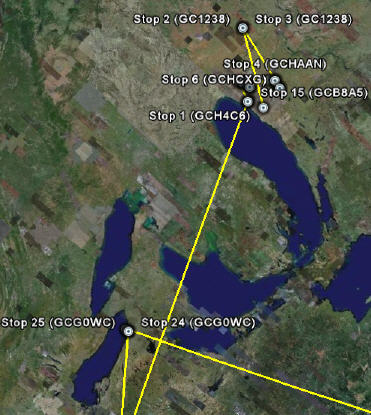
This shows a the path through the Midwest of a TravelBug (think Geocaching)

But first, a word about how place, as defined as our physical world, has always been subjective – that mash-ups are simply expressing this reality in another demonstration of The Long Tail. The above example from Google Earth is the path that a friend’s Travel Bug (lovingly named Tatoo Bug) took as it passed through Midwestern geocaches. This portion was the first leg in a worldwide, 15,951-mile trip that he and other enthusiasts continue to follow on the dedicated Geocaching site.

Just as blogging has shown what happens when you remove the high cost of entry to publishing, these new rich, personalized maps are what you get when you hand mapping tools to the masses. Think about what maps have been in recent history. And I define recent history as the time since researching and printing maps was only available to the chosen few.

When I was a child, living in the hinterlands of the Upper Peninsula of Michigan (also known at “The U.P.”), I was surrounded by towns that were too small for most maps to even acknowledge.

To cartographers, they didn’t exist. The commercial effects were devastating. 

Smack in the middle of a breathtakingly beautiful part of the country, with much to offer visitors, these tiny hamlets withered on the vine because tourists drove right past. These towns were achingly close to the tourist dollars they needed to survive. In some cases they were separated from major U.P. roads by nothing more than a stand of pine trees. So close and yet so far away.

That is all changing.

I’m a rock climbing enthusiast. The last time I climbed at Devil’s Lake, a spectacular set of quartzite climbing faces, I and my fellow climbers found the right place to set our gear based on an old, dog-eared book. The book was far from current, but it was the best we had. I’m expecting, within the year, to make my selection based on one or more Google Map mash-ups, enhanced with Flickr.com photos and user-generated raves, rants and warnings. My guide book will stay on the shelf, more a relic than reference.

And who knows? Maybe, armed with more personal — and personalized — knowledge of the area around Devil’s Lake, I’ll discover an ideal place to eat. One that I didn’t even know existed. A new perspective will reveal a physical world I didn’t realize was right there all the time.

Networks Can Intermediate Too

Is it inevitable that a networked world eliminates the middleman, shifting from an objective, imposed experience to a more subjective one? I thought so.

But on the same day that I read that Times article, I heard a wonderful NPR podcast. It was one of a series of programs called RadioLab, and this episode was about time. The program reminded me that there was an era in this county when small communities like my hometown had a very personal — and personalized — view of time. Up until about 200 years ago, these places had no official “time.” Noon was simply when the sun was directly overhead. You set your watch to that moment, and that was good enough.

Back then you could walk into a room and ask for the time, and get as many different answers as there were people answering. Some would even, quite sincerely, answer with something like “It’s nearly time for me to harvest the corn.” Because what was time, after all, but something you experienced subjectively?

One day that all changed, and everyone followed the same timeclock.

And the intermediary that created this change? None other than a network: The railroad.

With much at stake for both the train and the towns along its path, someone had to agree to exactly when the 12:07 train would pull up to the stop. The network wiped away all personal “maps” of time and replaced them with one that was objective and unyielding.

All of this is a reminder to me that two of the most agree-upon truths — Time and Space — which keep us moored to this harbor called Reality, are more open to interpretation that we would care to admit.

We all know that retail’s mantra and battle cry is Location, Location, Location. But the spread of map mash-ups helps us realize that what makes a location good is in the eye of the beholder. Take it from me: If what you want is a really good smelt fry, I know a place in Rapid River, Michigan that is worth seeking out.


Posted in Long Tail, Visualization, Web Marketing | No Comments »

Confirmation page growing in email marketing importance

Written by Jeff Larche on July 26, 2007 – 8:25 am -

A recent Direct Marketing Association study describes the growing popularity of super-simple subscription processes — sometimes just asking for an email address. But even more noteworthy is the clever twist of nailing down details within the confirmation page.

In a way this is just a semantic trick. Instead of the subscription process being a two-page “ordeal,” with Page Two saying something like: “Almost done! Now tell us what you’d like to receive in our eNewsletter,” the second page says, “Thanks for subscribing. Your first issue will arrive shortly. Now, if you tell us in the form below what content would be most welcome, we’ll be about to customize those messages precisely to your tastes.”

Such a simple change. And such a big improvement in conversion rates! Privacy assurances and transparency about how often the emails will arrive are also key to raising subscription conversion rates, according to the study.

Other findings, as described in Chad White’s blog about the report, are as follows:

  • Only 3% of major online retailers use a double opt-in subscription process.
  • Only 92% [sic] of retailers have an email sign-up form or link on their homepage.
  • More than 43% of retailers allow customers to sign up for email with one click from their homepage.
  • The subscriber’s name (31%) and zip code (18%) were the two most often required pieces of information.

What are you doing to improve your eNewsletter’s subscription process?


Posted in Email Marketing | No Comments »

If there is ever a Web 3.0 Mount Rushmore, Blaise Aguera y Arcas’ face will be next to Jeff Han’s

Written by Jeff Larche on July 23, 2007 – 11:35 am -

Let there be no doubt. The past year has given us a clear glimpse of Web 3.0 and how we will experience it. First Jefferson Han gave us the multi-touch interface to this new multi-dimensional world. Now Blaise Aguera y Arcas gives us the information architecture behind that glass rectangle. Blaise Aguera y Arcas is an architect at Microsoft Live Labs, and in this breathtaking video he shows what Ethan Zuckerman called, after this TED2007 (technology, entertainment, design) presentation, “Perhaps the most amazing demo I’ve seen this year.” You be the judge.

A demo of Photosynth


Posted in Visualization, Web Marketing | 1 Comment »

A magical feat worthy of Hogwarts: Harry Potter book materializes via text message incantation

Written by Jeff Larche on July 21, 2007 – 4:00 pm -

I read somewhere that Italy has more pet dogs than it does children. That is a bad thing in a country — a sign of negative population growth. However, I tell you very selfishly that this ratio — more dogs than kids — is an excellent thing in a high rise. Take mine for example. The elevators and lobby are teeming with canines, usually on the business end of leashes held by a slack-skinned residents such as myself.

So how do you account for the fact that the mail room of our building today was full of USPS notices of the arrival of the same parcel: The last in the Harry Potter book series? Obviously I’m not the only “kid at heart.”

But this kid has a decidedly geeky side. I pre-ordered mine three months ago using nothing but the keypad of my cell phone. As I stated then, in my account of ordering the book, the service that made this miracle of commerce possible is a harbinger of things to come.

Here were the steps I used to order my copy of this juvenile horse-choker:

I registered (just once) at the ShopText site. I provided the usual: My name and shipping address, and my credit card information. I also gave them my email address and cell phone number. That’s when the real wizardry began.

I received a receipt via email and SMS (i.e., cell phone text message). It included my short password, something needed to avoid ordering fraud

Then, all I had to do was send a text to ShopText’s “short code,” which is a 5- or 6-digit cell phone number that communicates with an SMS server. I placed the keyword in the message body, “Potter,” as instructed in the print ad that offered this ordering option.

I received a confirmation on pricing, which also requested the security password. Once received, the system sent my cell phone — and my email Inbox — a receipt for the purchase. Poof! Within three minutes I had scratched my itch and bought this last of the Harry Potter series.

And that’s the point.

If SMS ordering catches on at all, it will be because of the ease with which spontaneous purchases can be made before having time to think something like, “Heck, I can always go to the bookstore.”

This is a system that deserves to succeed, and it probably will, considering what big, pampered kids I and my fellow boomers have become.


Posted in Mobile Marketing | 2 Comments »

Explosion causes a potty-mouthed Twitter skeptic to see the light

Written by Jeff Larche on July 20, 2007 – 4:52 pm -

I had vowed to readers I would never again write about Twitter. It is, after all, a frivolous little diversion. True, in the same breath, I had also acknowledged (in one of my last posts on the topic) that this trivial toy has the potential to save lives. It can spread news when all other sources are slow to arrive or completely cut off. In a time of rising terrorist threat levels around the world, that makes Twitter sound far less trivial.

Proof of my theory arrived today. Here’s the story that has brought me out of my Twitter silence. Warning: The blog entry I cite, on the other side of this link, includes a profanity in one of the images.

A friend had been trying to coax Howard Lindzon into the Twitter habit. He refused, and finally conceded only on this condition: His “Tweets” would only come from him via his cell phone, and only when he was — ahem — using the facilities. Since he considered Twitter a waste, he was only going to Twitter about waste. But that all changed when there was a terrifying steam pipe explosion. Caught with no other way to get or receive news about it, you can guess where he turned:

Lindzon uses the one tool he bashes and pokes fun at to inform and hopefully inform himself of a crisis situation. Instantly! Wirelessly! … My buddy Loic Le Meur’s twitts a few days ago about how he catches up with news on Twitter more that by reading his RSS.

Now excentric [sic] Lindzon accepts my invitation to join and unwilingly [sic] offers this awesome example of the right person at the right time in the right place using the right service and instantly informing his peers he networked with registering to Twitter. Is this the real web 2.0? Ought to be, as Lindzon did not blog or email about the blast. He freakin twittered it!

When the telephone was invented, it wasn’t thought of as a tool for doing business. It was imagined by most as a way, before consumer radio appliances entered the picture, of carrying music and news across great distances. That all changed of course. Relatively speaking, it didn’t take long for this “toy” to earn its keep in society (just a few decades).

Could Twitter, the first truly widespread mobile time-waster, be on its way to its own social legitimacy?


Tags: , ,
Posted in Mobile Marketing, Social Networks | No Comments »

Make sure your mass emails look good naked

Written by Jeff Larche on July 18, 2007 – 3:20 pm -

My Gmail account is set so I don’t see images embedded in emails unless I choose to, on a case-by-case basis. I just received another email today from the company that sent the one below. In both cases, I had no idea who was sending it to me, unless I remembered what company is behind the Goldpoints Plus continuity program I subscribed to ages ago (fat chance!). Can you tell me who this is? This is a screen capture of the first one I received.

With the images turned off. If you don’t see anything below this image, click on the MORE link to see who it is.

And here is what that same email revealed once I turned on the images:

Read more »


Posted in Email Marketing | No Comments »

What playwrights can teach about strong ad copy

Written by Jeff Larche on July 17, 2007 – 11:32 am -

Playwrights listen to the way people talk. The best of them turn this spoken music into something more than the merely authentic. They use it to convey a higher truth (even if the play simply makes us laugh; or maybe especially if it does). So what about ad copy — be it online, on a printed page or whatever?

Must jarring authenticity go out the window as the “polish” of professionalism is applied to an ad? This week, Roy Williams made an eloquent case for sparing some of the polish that can water down an ad and sap its power.

Williams even makes reference to a wonderful statement in the first chapter of a book of his — a book I’d recommend to anyone who is looking for a fresh perspective on advertising and marketing. Right there on Page 12 of The Wizard of Ads are these “Nine Secret Words”:

The risk of insult is the price of clarity.

Think of this the next time you review a proposed ad that is a little too jarring for your comfort. It could be bad, or unwise. This is always possible. BUT, it might instead be the most effective marketing investment you make this year.

Advertising legend David Oglivy once wrote that the ideal copywriter is “half killer and half poet.” I don’t know any professional killers, but I do have my favorite poets. Most of them, from what I’ve read about them, would be about as welcome in “polite company” as a paid assassin. Or a brilliant playwright, for that matter.

Could it be that this untamed, feral quality in art is something you should be looking for in commerce — in your next online ad, perhaps?


Posted in Direct Response, Online Copywriting, Web Marketing | No Comments »

Serving SUPERVALU customers one niche at a time

Written by Jeff Larche on July 8, 2007 – 12:37 pm -

I really like the direction that Kevin Hillstrom’s One Positive Day blogging concept is taking. While I used the occasion this month to share a favorite work tool, Kevin was inviting many of his social networking and database colleagues to speculate on how to improve the online presence of SUPERVALU, a grocery and pharmaceutical retail and supply chain company.

I’ve had the luxury of a week since that July 1 post to think about my response. I started with the question of corporate mission. There are many ways to drive consumers to your site, such as an online version of the old “Green Stamps” promotion, but as Kevin states at the end of his post, you ultimately have to show something beyond raw page views. You have to add to the stores’ bottom lines, either by saving money by automating something that is now labor-intensive, or generating greater sales totals, or both.

In the comments, Ron Shevlin and another contributor mentioned how helpful it would be to create an aisle-by-aisle shopping list of items. I can understand the logistical challenge of this, since every store floor plan seems to be at least a little different, something exacerbated by the thousands of new products introduced (and pulled!) every year. This last point was made another contributor to the dialog — 10-year food business veteran Harry Joiner.

A Store-generated Shopping List

I had even wondered if something could be done with a mobile-enabled service. For instance, from your cell phone, you call or text a list to a SUPERVALU short code. Then, either through voice recognition (in the case of a voice call) or standard database look-up, you get back a list in your email box, ordered in the walking pattern of the store and complete with related specials and exclusive couponing.

Perhaps something could even be done with a WiFi-enabled version of this voice-activated shopping list device. This device would take your family’s accumulated voice lists of groceries, digitize the list into text using its native voice-recognition system, and — after it is sent via a wireless internet connection to SUPERVALU computers — the device receives and prints the final list with coupons.

This certainly would align itself with SUPERVALU’s Mission  Statement: ”To serve our customers better than anyone else … provide our customers with value through our products and services, committing ourselves to providing the quality, variety and convenience they expect.” The mission statement goes on to talk about building strong communities surrounding its stores, which is the other theme of how to help this web site become a greater contributor to the store’s success.

Harry Joiner mentioned creating Ning-like online communities surrounding each of the most significant lifestyle and demographic categories. He gave some examples of how other product marketers have succeeded with this tactic.

A few community examples for SUPERVALU that spring to mind are the following: Young, growing families, single adults looking for tips on cooking for one (and perhaps even place-based events specifically for singles), and of course cooking enthusiasts.

Some value-creating tactics could be things like product-related cooking demonstrations or give-aways, or tie-ins with non-profits that the SUPERVALU business supports through its foundation. Only online community members would be privy to them, of course. One thing is clear. These communities would need to find a great deal of value on the sites.

Many companies have tried to build a critical mass among their “wired niches.” Most have failed.

And speaking of long tale strategies, here’s one that my friend Steve Ward had cooked up well over 10 years ago, and I think still has promise: An online database of all nutritional information for every product on the shelves (or as many as possible)!

Those who are striving to reduce their sodium or fat consumption, or improve their nutrient intake, could create shopping lists that tell them the exact nutritional values of what they eat.

Would this, or any of the above ideas, fundamentally change the way SUPERVALU returns shareholder value? No. Would it help the company fulfill its mission? Absolutely. But like so many online endeavors, this would be accomplished slowly and at a significant investment, one niche at a time.


Posted in Database Marketing, Email Marketing, Long Tail, Mobile Marketing, Web Marketing | 2 Comments »

Steve Rubel finds a novel way to report on iPhone launch

Written by Jeff Larche on July 3, 2007 – 1:40 pm -

If you’re covering the launch of a mobile device, and it’s as revolutionary as the Apple iPhone, how do you post in a way that’s novel and immediate? If you’re Steve Rubel of Edelman, and write the influential blog Micro Persuasion, you blog from a mobile device. All while standing in line for the gizmo it is destined to be replaced by.

Here is Rubel’s Twitter feed over that period. For those not familiar, the top posts are the most recent. You can review even by clicking the “More” link I’ve provided.

I’m sorry there aren’t live links (I grabbed these as graphics off the posts Sunday night), but if you’d like to find the originals they should be available for a while at Steve Rubel’s Twitter Home Page.

Read more »


Posted in Mobile Marketing, Web Marketing | No Comments »

Thinking in mapped networks, with connections real and implied

Written by Jeff Larche on July 1, 2007 – 7:35 pm -

More than a year ago I started telling trusted friends and colleagues about a great piece of software. Half-joking, I would lean forward and confide that this is one secret too valuable for me to blog about. The digital equivalent of a performance-enhancing drug, it was something I’d prefer not to leak to competitors. That is, until today. In the spirit of openness, and timed to coincide with my friend Kevin Hillstrom’s One Positive Day campaign for blogging civility, I am ready to spill the beans.

Thinking With Both Sides of the Brain

Ever since my college days I had wondered if there was a smarter way to organize my thoughts. Common note-taking techniques didn’t seem to cut it. Looking around, I wasn’t optimistic. Certainly the first personal computers, with their DOS-like lists, hierarchies and sequences, were of no help.

Then I found the books of British “pop psychology” author Tony Buzan. In a Madison, Wisconsin used bookstore, I discovered the first: a copy of his 1974 Use Both Sides of Your Brain, where he talked about something called mind mapping.

Buzan wrote that standard outlines require scanning from left-to-right, top-to-bottom. This causes the brain to work harder to make the interconnections between concepts.

Back then Buzan couldn’t have envisioned the modern solution to this dilemma, which is to boil lists down to a point where they lose much of their potential meaning and utility. Or conversely, the author will stretch out the information across a blinding sheaf of slides and spray of “bullets.”

I’m referring to Powerpoint of course, a product that Edward Tufte, author of The Visual Display of Quantitative Information and other classics, so eloquently lambastes in this essay.

Our brains are built to survey information as it is seen in the physical world, making associations through placement, space, distance and color. The more complex the subject, the greater our brain resists tidy categorizations and rankings.

Thinking In Mapped Networks

Enter the mind map. The illustration below shows a hand-drawn example. It’s one Buzan that would have been proud to call his own.

An example of a hand-drawn mind map

To the person who drew it, there is more meaning here than could be crammed into a dozen pages of lists.You can instinctively see how these maps help with lateral associations while still allowing for more formal hierarchies and sequences. As you might expect, some maps are never really completed by their owners. They are continually refined. New insights and perspectives leap off the page with every rereading. This is a good thing, because it shows how concepts can grow and deepen over time.

That was Buzan’s point, and luckily, many modern software developers have listened.

An advantage of the computer-based mind mapping tools is they are easier to share with others (you can even port some softwares’ output to other programs, including … Powerpoint!). Annotation features also help. They add explanation that is needed when you’re showing your map to others — or just trying to remember what the heck you meant when you drew it!

The best mapping tools can even be used as collaborative brainstorming aids. I’ve checked out several over the years, and the best by far is the award-winning Mind Manager. Visit MindJet.com to see for yourself.

Put bluntly, it could change the way you think.


Tags: , , , ,
Posted in One Positive Day, Visualization | 6 Comments »
RSS